
Scroll Top
4801 Bennett Rd. Toledo, Ohio 43612

How to Choose the Right Flying Shear Machine?

Choosing the right flying shear machine starts with the line, not the catalogue. A shear must match strip width, thickness, grade, line speed, and target cut length. A mismatch can leave burrs, distort the leading edge, or interrupt production. Small details matter. Watch the strip enter the cutter: does it stay flat, and does the machine keep pace without pulling the material?

The scale of steel production makes these decisions consequential. World Steel Association’s World Steel in Figures 2024 reports that global crude steel production reached 1.892 billion tonnes in 2023. That figure describes the sector, not demand for flying shears. Still, it shows why dependable cutting and reduced downtime matter on busy processing lines. Compare cutting accuracy, synchronization response, blade life, changeover time, and access to maintenance support. Ask suppliers for test results using material close to your actual production conditions. A brochure’s maximum speed is not a production guarantee.

One important sourcing point remains: no supporting articles or verifiable flying-shear expert quotation were provided. I won’t invent a specialist’s name or quote. Before purchasing, request a documented reference installation and a demonstration using your strip dimensions and operating speed. Listen for vibration. Check how quickly operators can inspect the blades. Then weigh the results against your maintenance skills and production targets. The best machine is not automatically the fastest. It is the one that cuts reliably in your real line conditions—and is practical to maintain when something goes wrong.
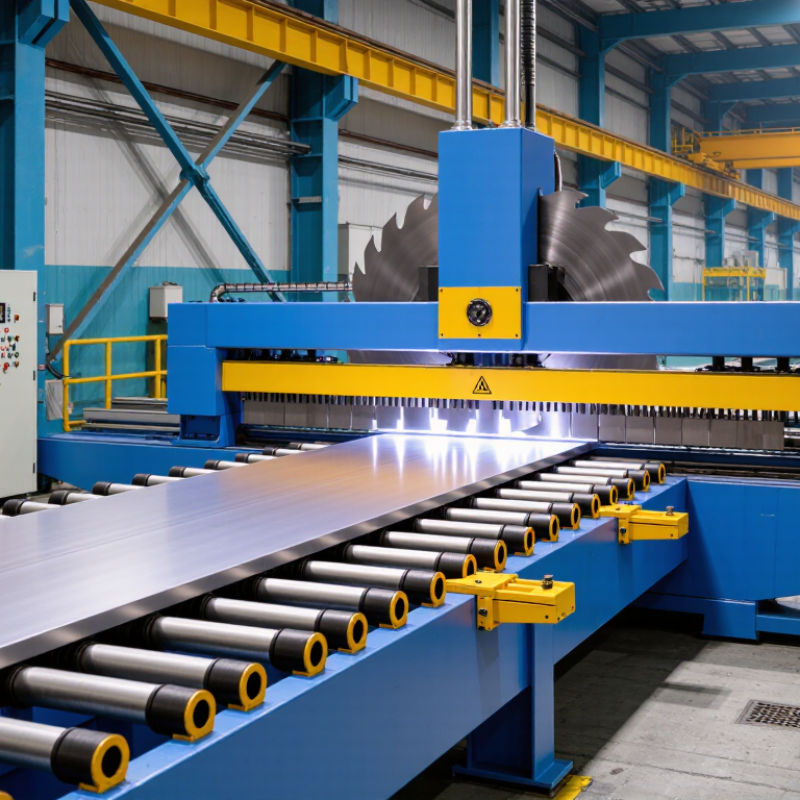
How to Choose the Right Flying Shear Machine?

Define the Production Requirements and Cutting Objectives

Before comparing flying shear machines, define the material, dimensions, and production target. Record the actual coil thickness, strip width, grade, and expected variation—not just nominal values. Then specify line speed, cut length, length tolerance, squareness, and cuts per minute. A thin, wide strip may behave differently from a thick, narrow one, even at the same line speed. World Steel Association’s 2024 Short Range Outlook estimated global steel demand at about 1.75 billion tonnes for 2024. That scale signals production pressure, but it does not set your required machine speed. Your line data does.

Write down the operating cases that matter: normal running, acceleration, deceleration, and any planned material changes. Ask suppliers to demonstrate the target cut length at your real speed and material thickness. Measure the part after cutting, including burrs and edge condition. Numbers need context. A trial with one convenient coil can hide problems. The U.S. Department of Energy’s 2022 Industrial Decarbonization Roadmap notes that manufacturing efficiency depends on process-level improvements; in a shear line, avoidable scrap and repeated adjustments are useful indicators to track. One detail is easy to miss: operators may value stable cuts more than the highest advertised speed. I would verify that assumption with production staff, since shop-floor priorities are not always captured in the specification.

Match the Shear Type to the Material and Line Speed

Match the shear to the material and the line’s real operating speed. A rotary shear often suits continuous strip and frequent cuts. A servo-synchronized guillotine can offer more flexibility in cut length. For thicker or higher-strength stock, check required cutting force and blade clearance; speed alone is not enough. Verify thickness, tensile strength, width, cut tolerance, and burr limits against the machine’s rated capacity. A small mismatch can cause chatter or rough edges.

The World Steel Association’s World Steel in Figures 2024 reports 1,892.2 million tonnes of crude steel production in 2023. That industry-wide figure is not a machine-speed benchmark: each line’s safe output depends on its stock and setup. For example, a line running at 120 metres per minute and cutting every 1.2 metres needs 100 cuts per minute, before allowing for synchronization and acceleration. Check that the shear can reach and hold that cycle rate with the actual material.

Tips: Test with production-grade stock, not just a thin sample. Review encoder feedback, cut accuracy, and edge quality at target speed. One detail is easy to miss: coil variation can change results, so leave room for adjustment.

Verify Cutting Capacity, Accuracy, and Product Dimensions

Choose a flying shear from the cut you actually need, not its headline speed. Record material grade, thickness, strip width, line speed, and shortest cut length. World Steel Association’s World Steel in Figures 2024 reports 1,892.2 million tonnes of crude steel production in 2023. That scale shows the industry’s high throughput, but it does not define your machine’s capacity. Your own production recipe does.

Ask for cutting capacity at your thickest, strongest material and highest operating speed. Check the rated range against the mill certificate, not just a generic “mild steel” specification. Accuracy must be tested while the line is moving. Set a target cut-length tolerance, then measure repeated cuts across a full production run. Small errors add up. Even a careful setup can drift.

Confirm finished length, width, squareness, and edge condition against the drawing. For hot-rolled strip, EN 10051 provides dimensional and shape tolerances; match the correct table to the material and thickness. Run a trial with your actual coil and inspect parts at the beginning and end. A machine may meet a brochure specification yet struggle with a short cut at full speed. That detail is easy to miss.

Assess Controls, Integration, and Machine Safety

How to Choose the Right Flying Shear Machine?

Assess the controls, integration, and safety features as carefully as cutting speed. A flying shear must track the moving material and cut at the required length without stopping the line. Ask to see how operators set length, speed, and acceleration on the control panel. Can they spot an incorrect value before production begins? Clear alarms and readable displays matter during a noisy shift. Small details count.

Tips: Request a demonstration using material and line speeds close to your actual process. Check how the machine responds to a sensor fault, jam, or emergency stop. Confirm that guards, interlocks, and safe access points suit your maintenance routine. Write down any assumptions.

Integration can be harder than expected. Verify signal compatibility with upstream and downstream equipment, and agree on who handles commissioning and troubleshooting. Review the cut-length tolerance across different speeds, not only at one ideal setting. Ask how settings are backed up and restored after a control failure. Safety checks should include access during cleaning and blade changes, when routine work can create overlooked risks. A polished demonstration is useful, but it cannot reveal every production problem. Leave time for a real-line trial and record what needs adjustment.

How to Choose the Right Flying Shear Machine? - Assess Controls, Integration, and Machine Safety
Assessment Area What to Evaluate Suitable Evidence or Acceptance Check Priority
Line speed and cutting capacity Confirm the required operating-speed range, material thickness and width, cut length, and expected production rate. Check that the shear can track the moving material throughout the specified operating envelope. Review the machine’s documented operating limits and run a trial using representative material at the intended speeds and cut settings. Essential
Cut-length accuracy Assess the required length tolerance and how the control system compensates for line-speed variation, acceleration, deceleration, and material slip. Agree on a measurable tolerance and inspection method before testing. Record cut-length results across a representative production run. Essential
Motion control and synchronization Check how the carriage and blade motion synchronize with the material line, including tracking, return motion, and recovery after a stop or interruption. Review the control sequence and demonstrate tracking through normal starts, stops, speed changes, and a controlled restart. Essential
Operator controls and visibility Evaluate the human-machine interface, status indicators, alarm messages, recipe selection, access levels, and visibility of operating conditions from the operator position. Ask operators to complete routine tasks and respond to representative alarms. Confirm that instructions and messages are clear and actionable. High
Recipe and parameter management Determine whether settings for different materials and products can be stored, recalled, protected from unintended changes, and backed up. Demonstrate recipe selection, authorized parameter changes, user access controls, and restoration of a saved configuration. High
Control-system compatibility Check compatibility with the existing line’s control architecture, communication protocols, encoder signals, I/O, and required data exchange. Request an interface list and control-system drawings. Verify signal ownership, communication behavior, fault handling, and responsibility for integration. Essential
Upstream and downstream coordination Assess how the shear coordinates with feed equipment, accumulators, conveyors, stacking systems, and line-level start/stop commands. Test normal production, planned stops, emergency stops, and restart sequences with the connected equipment or a documented integration simulation. Essential
Safety risk assessment Confirm that hazards such as blade access, moving carriage motion, pinch points, ejected material, and maintenance tasks have been assessed and addressed. Request the machine risk assessment and safety documentation. Review the design approach against applicable local regulations and relevant standards, such as ISO 12100. Essential
Guards and safety devices Review fixed and movable guards, interlocks, access points, presence-sensing devices where appropriate, and measures that prevent access to hazardous motion. Inspect guard coverage and verify that interlocks and protective devices act as intended under the documented test procedure. Essential
Emergency stop and safe stopping Check emergency-stop locations, stop behavior, reset requirements, and how the shear responds to loss of power, communications, or control signals. Witness documented functional tests. Confirm that reset does not itself initiate unexpected motion and that stopping performance is suitable for the installation. Essential
Safety-related controls Determine whether safety functions, such as guard interlocking and emergency stopping, are designed and validated to the required level for the machine’s risk assessment. Review the safety-function documentation and validation records, with reference to applicable requirements such as ISO 13849-1 or IEC 62061 where appropriate. Essential
Electrical and maintenance safety Check electrical documentation, isolation points, stored-energy controls, safe access for blade changes, and procedures for cleaning, inspection, and maintenance. Review wiring diagrams, isolation instructions, and maintenance procedures. Confirm that service tasks can be performed without bypassing safeguards. High
Diagnostics and fault recovery Assess whether alarms identify the affected subsystem and provide useful guidance for resolving faults without encouraging unsafe bypasses. Introduce representative faults during an approved test and verify alarm clarity, fault logging, and the documented recovery sequence. High
Commissioning and acceptance testing Agree on installation checks, control and safety tests, production trials, acceptance criteria, and responsibility for resolving integration issues. Use a written acceptance plan covering operating modes, product settings, interfaces, safety functions, and measured production results. High
Documentation and training Confirm availability of operating, electrical, safety, and maintenance documentation, plus training suited to operators and maintenance personnel. Check that documentation matches the delivered configuration and that relevant personnel can demonstrate routine operation and safe fault response. High
Serviceability and spare parts Consider access to wear parts, blade replacement requirements, diagnostic support, and the expected availability of critical components. Review the recommended spare-parts list, maintenance schedule, service response arrangements, and the tools or skills needed for routine work. Medium
Selection tip: Define production requirements and safety expectations first, then verify controls and interfaces through documented reviews and practical acceptance tests.

Compare Supplier Support, Maintenance, and Total Cost of Ownership

How to Choose the Right Flying Shear Machine?

A flying shear’s purchase price tells only part of the story. Compare supplier response times, technician availability, training, and spare-parts lead times. Ask who handles commissioning and how quickly support is available when a cut-length fault stops the line. Details matter. Check the maintenance plan for blade changes, lubrication, alignment, and calibration. A machine may look simple on paper, yet small setup issues can create costly downtime.

Total cost of ownership should include installation, energy, tooling, labor, planned service, and production losses—not just the quoted price. McKinsey’s 2018 analysis of predictive maintenance reported potential downtime reductions of 30–50% and machine-life extensions of 20–40%. These are cross-industry estimates, not guaranteed results for flying shears. Still, they underline why service quality and condition monitoring belong in the cost comparison. A tidy spreadsheet can miss real-world delays; review the assumptions with operators and maintenance staff.

Tips: Request a sample maintenance schedule and a written spare-parts list. Compare service commitments and expected costs across the machine’s planned operating life. Ask for references from plants with similar line speeds and materials. A little uncertainty is normal—record it rather than hiding it.

How to Choose the Right Flying Shear Machine?

Compare supplier support, maintenance, and estimated five-year total cost of ownership (TCO).

Illustrative support scenario Target initial response Planned maintenance labor
Remote-first support Within 24 hours About 32 hours/year
Regional service coverage Within 8 hours About 24 hours/year
Priority local service Within 4 hours About 20 hours/year

Illustrative planning estimates, not supplier quotes or universal benchmarks. TCO assumes comparable machine capacity and includes purchase, commissioning, energy, maintenance, and spare parts over five years. Request itemized quotes and confirm service response terms, spare-parts availability, and maintenance requirements for your operating conditions.