
Scroll Top
4801 Bennett Rd. Toledo, Ohio 43612

What Is a Roller Mill Machine and How Does It Work?

A roller mill machine reduces grains and other bulk materials between rotating cylindrical rollers. It is widely used in flour production, animal feed processing, and selected industrial applications. The machine’s value lies in controlled particle reduction, not simple crushing. Operators adjust the roller gap, rotation speed, and feed rate to influence the final texture.

Inside the machine, material enters through a hopper and moves toward the roller pair. The rollers pull it into a narrow space. Pressure, friction, and shear then break or flatten the particles. A sifting system may separate fine flour from larger pieces, allowing repeated passes when needed. The result depends on grain hardness, moisture, roller surface, and machine settings. Small changes matter.

A practical explanation must include limitations. Excessive pressure can create heat, uneven particles, or unnecessary wear. Poorly cleaned rollers may also affect product quality. Regular inspection helps identify damaged bearings, worn surfaces, and unstable feeding before they cause larger problems. Safety guards and approved operating procedures remain essential.

Not every material behaves alike.

This guide explains how a roller mill machine works, what its main components do, and why correct adjustment matters. It also considers efficiency, maintenance, and product consistency from an operator’s perspective. Some applications require specialized designs, so general advice should not replace manufacturer instructions or professional assessment. The technology is straightforward in principle, but real performance often depends on details that are easy to overlook.
What Is a Roller Mill Machine and How Does It Work?

Roller Mill Machines: Definition, Purpose, and Main Applications

A roller mill machine reduces grain through rotating cylinders instead of impact alone. Adjustable gaps control particle size, while differential roll speeds create cutting and compression. In practical use, operators inspect the flour, feed, or crushed grain after each pass. Small changes in moisture can alter the result.

Its main purpose is controlled size reduction. In flour milling, grooved rolls open wheat kernels, while smooth rolls gradually refine the endosperm. The International Grains Council’s Grain Market Report 2024/25 placed global wheat production near 800 million tonnes. That scale explains the demand for efficient, repeatable milling systems. Feed plants also use roller mills to process maize, barley, and other grains. The resulting particles can improve handling and support more consistent mixing.

Applications extend beyond food production. Farmers and feed processors use compact machines for on-site grain preparation. Industrial plants use multiple roller pairs, sifters, magnets, and aspiration equipment. The U.S. Department of Agriculture’s Grain and Feed Annual reports regularly show strong grain-processing activity across major producing regions. However, the machine is not a universal replacement for hammer milling. Hard materials, poor cleaning, or incorrect roll pressure can reduce performance. The boundary is not always clean. Experienced technicians still check temperature, vibration, dust, and particle distribution manually. Data helps, but judgement remains necessary.

Core Components and Structural Design of a Roller Mill

A roller mill machine reduces grain between two cylindrical rolls. One roll rotates faster than the other. This speed difference creates compression and controlled shear. The result is a more uniform particle size than impact-only grinding.

Its core structure includes feed gates, grooved or smooth rolls, bearings, a drive system, and a roll-gap adjustment mechanism. A heavy frame keeps the rolls aligned under load. Magnetic protection removes metal before it reaches the grinding chamber. In practical operation, even a small gap change can alter flour texture, throughput, and temperature. The design is simple, but alignment is unforgiving.

The 2023 Global Feed Survey reported global feed production above 1.2 billion tonnes, increasing demand for dependable particle control. The U.S. Department of Energy’s 2022 Industrial Decarbonization Roadmap also identifies process equipment efficiency as an important industrial energy concern. Roller mills can reduce unnecessary impact and often produce lower dust levels, although results depend on grain moisture, roll condition, and operator settings. A worn bearing may waste power quietly. That detail is easy to miss. Regular inspection should include roll parallelism, belt tension, product temperature, and particle-size testing. Visual checks help, but laboratory measurement remains more reliable. The structure still needs refinement. Small feed variations can expose weaknesses that a clean machine hides.

What Is a Roller Mill Machine and How Does It Work?

Representative Particle-Size Reduction Through a Roller Mill

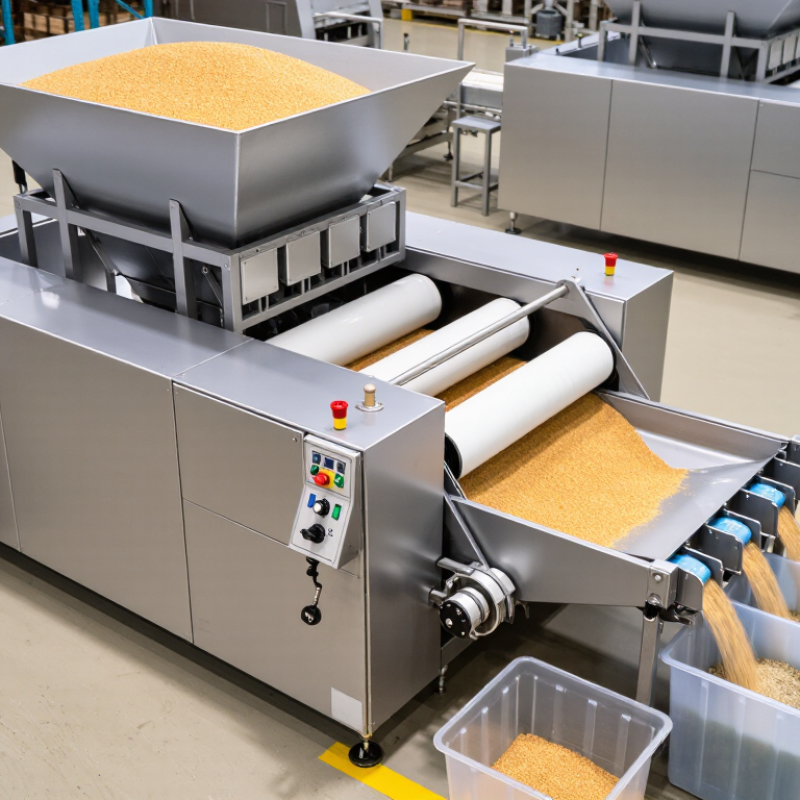
A roller mill reduces material size by drawing feed between two counter-rotating rolls. Compression and shear forces act at the nip, while the roll gap controls the final particle size.

  • Feed hopper: Delivers material evenly to the roll pair.
  • Rollers: Apply compression and shear during size reduction.
  • Adjustable roll gap: Determines the approximate product size.
  • Drive system: Maintains the required roller speed and torque.
  • Scraper and discharge: Remove processed material and reduce buildup.

The values shown are representative industrial operating values for a staged roller-milling example. Actual results vary with material hardness, moisture, roller surface, feed rate, and roll-gap settings.

How Material Moves Through the Roller Milling Process

A roller mill machine reduces grain and other dry materials by passing them between rotating cylinders. The process begins in a feed hopper, where an adjustable gate controls the incoming flow. Steady feeding matters because uneven material can overload one side of the rolls. In practical operation, technicians watch the sound, vibration, and product texture. These small signals often reveal problems before instruments do.

Inside the machine, the material enters the roll gap and meets compression, shear, or both. Corrugated rolls grip larger particles and break them into smaller pieces. Smooth rolls then flatten or reduce the particles more gently. Some machines use rolls with different speeds, creating additional rubbing action. The gap must match the material and target size. Too narrow, and heat and power demand may rise. Too wide, and the product remains coarse.

After each pass, the milled material moves through a separation stage. Screens or air systems sort fine particles from larger fragments. Oversized material may return for another pass. Not perfectly.

This repeated movement creates a controlled milling path rather than one dramatic crushing step. Operators may adjust feed rate, roll pressure, airflow, and temperature during production. Moisture also changes how material behaves. Dry grain can crack sharply, while conditioned grain may separate more cleanly. A reliable roller milling process depends on measured settings, regular inspection, and careful sampling from different points in the product stream.

Key Factors That Control Milling Performance and Output

What Is a Roller Mill Machine and How Does It Work?

A roller mill machine reduces grain between two rotating cylinders. The rollers create compression, shear, and controlled particle breakage. The gap determines how finely the material is ground. A wider gap increases throughput, while a narrower gap improves fineness.

However, excessive pressure can raise heat, energy use, and roller wear. Milling performance depends on several linked settings, not one adjustment.

Feed rate strongly affects output stability. An overloaded mill may produce uneven particles and sudden motor strain. Moisture also matters. Grain that is too dry can create excess dust, while damp material may smear between the rollers.

Roller speed and speed difference influence both capacity and particle shape. Sharp corrugations improve grip, but worn surfaces reduce consistency.

Operators should check particle-size samples during production, not only after a batch ends. Small changes can matter.

Tips:

Keep the feed stream even across the roller width. Measure moisture before milling and record every setting. Inspect roller surfaces, bearings, and screens regularly. Leave enough cooling time when temperatures rise. A simple logbook often reveals patterns that memory misses. Do not chase maximum output every day; stable quality is usually more valuable. Some settings may look efficient at first, yet create hidden losses through rework and maintenance.

Common Roller Mill Types, Benefits, and Practical Limitations

A roller mill machine reduces grain between rotating cylinders. Fluted rolls usually crack wheat, while smooth rolls produce finer flour. Two-high mills suit simple crushing duties. Four-high and multi-high designs improve control by separating working rolls from larger backup rolls. Modern milling systems often use several passages, not one aggressive reduction step.

The USDA’s May 2025 WASDE report estimated global wheat production near 808 million metric tons for 2025/26. That scale explains the appeal of continuous roller milling. Compared with impact grinding, properly adjusted rolls can deliver consistent particle size, lower heat exposure, and useful separation between bran, germ, and endosperm. Yet performance depends on moisture, roll gap, differential speed, and feed uniformity. Worn flutes create uneven particles. Excessive pressure can increase fines and energy use. The IEA reports that motor-driven systems consume roughly half of global electricity, so inefficient drives deserve attention. Practical limits are easy to underestimate. Noise, dust, vibration, and regular roll servicing remain part of daily operation.

Tips: Check roll parallelism before changing the gap. Measure feed moisture at several points. A mill that looks stable may still be producing inconsistent flour. Keep a simple maintenance log, then compare energy use with yield. Small trials are safer than relying only on settings from another plant. (Sources: USDA WASDE, May 2025; International Energy Agency, motor systems analysis.)