
Scroll Top
4801 Bennett Rd. Toledo, Ohio 43612

How to Choose the Right KUKA Machine?

Choosing the right kuka machine starts with the task, not the brand name. A robot lifting 80 kilograms needs different priorities from one placing tiny electronic parts. Reach, payload, repeatability, cycle time, and mounting position shape the decision. So does the working environment. A dusty foundry is not a clean assembly cell. Small details matter.

This guide approaches selection from an engineering and purchasing perspective. It considers robot families, controller compatibility, tooling, software, maintenance access, and total operating cost. Official KUKA specifications provide essential limits, but they do not replace a real cell assessment. Measure the part envelope. Record the heaviest payload. Watch the fastest motion. Then test the proposed kuka machine with the actual gripper and fixtures, if possible. Simulation can expose reach problems before installation, although it may not predict every cable snag or operator interaction.

Reliable advice also includes safety and long-term support. Confirm guarding, risk assessment, emergency stops, training, spare-part availability, and qualified integration before production begins. Local regulations and site procedures must guide the final design. The cheapest quotation may become expensive after downtime, tooling changes, or difficult programming. That assumption deserves challenge. A technically impressive arm can still be the wrong choice if technicians cannot service it confidently. By balancing measurable requirements with practical experience, readers can select a kuka machine that fits today’s process and supports future changes. No choice is perfect.
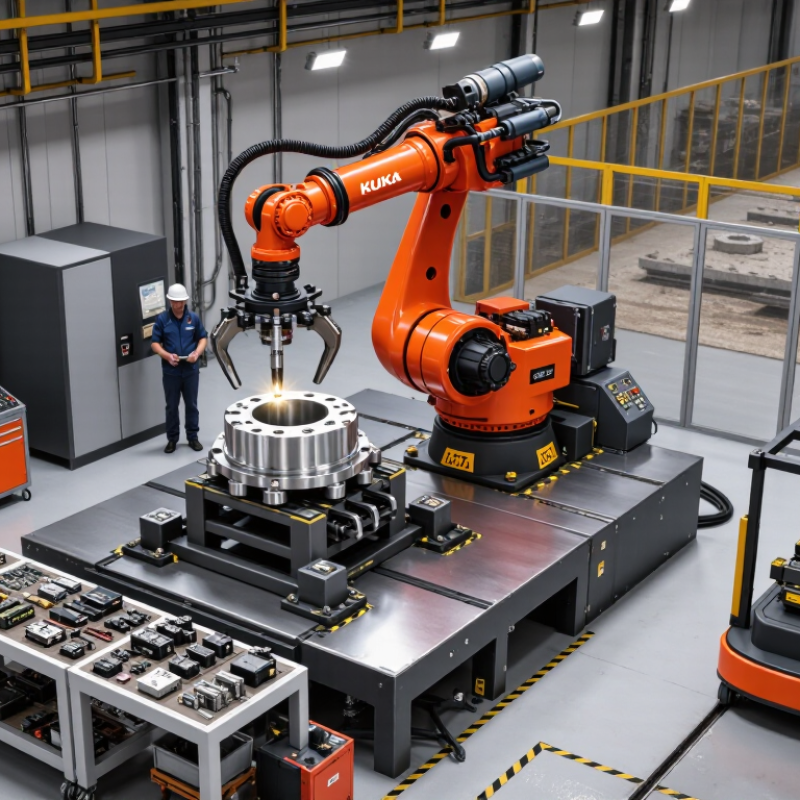
How to Choose the Right KUKA Machine?

KUKA Machine Categories and Their Core Applications

When choosing the right industrial machine, start with its category and application.

Articulated robots suit welding, painting, palletizing, and complex assembly. Their multiple joints reach around fixtures and into awkward spaces. They need careful programming and sufficient floor clearance.

SCARA machines excel at fast, repeatable horizontal assembly. They can place small components, tighten screws, and load circuit boards.

Delta robots handle lightweight products at very high speeds. They often serve food, packaging, and sorting lines.

Cartesian machines move along fixed axes. They provide predictable accuracy for cutting, dispensing, machining, and large-format handling.

Collaborative models support selected tasks near workers, but they still require risk assessments, speed limits, and suitable tooling.

The practical choice depends on payload, reach, cycle time, accuracy, and working conditions. Measure the heaviest product, including the gripper. Check whether dust, moisture, heat, or washdown exposure affects protection requirements.

A machine that reaches the target may still lack useful wrist flexibility. That detail is often missed.

In factory assessments, I also review maintenance access, spare-part availability, operator training, and software compatibility. A neat spreadsheet can still mislead. Test the complete motion with real parts, cables, fixtures, and packaging. Then compare energy use and future expansion costs. The cheapest category may become expensive when every small change needs custom engineering.

Key Specifications for Comparing KUKA Machine Options

Choosing the right industrial machine starts with measurable specifications, not catalog impressions. Define payload with the tool, cables, and workpiece included. A six-kilogram load may become nine kilograms after tooling. Reach must cover the farthest fixture without forcing awkward wrist angles. Check repeatability under real speed and temperature conditions. ISO 9283 provides a useful framework for comparing robot performance.

Speed figures need careful interpretation. Manufacturers may quote maximum joint speed, while production depends on acceleration, path accuracy, and cycle complexity. Request a sample cycle using your actual part. IFR’s World Robotics 2024 report recorded 541,302 industrial robot installations worldwide in 2023, showing how widely automated equipment is being adopted. Yet higher speed does not automatically deliver better output. Poor gripping or frequent pauses can erase the advantage.

Environmental and lifecycle specifications deserve equal attention. Compare the IP rating with washdown exposure, dust, heat, and chemical contact. Review controller response time, network compatibility, safety functions, maintenance intervals, and spare-part availability. Energy consumption matters during long shifts, although published figures often exclude auxiliary equipment. I would treat those numbers cautiously. A practical factory trial remains more convincing than a polished datasheet. Record cycle time, reject rate, noise, temperature rise, and recovery time after a simulated fault. Reliability depends on integration quality, operator training, and service support, not only the machine’s headline payload.

How to Match Machine Capabilities with Production Requirements

How to Choose the Right KUKA Machine?

Choosing a machine starts with the production task, not the catalog headline. Define the part weight, dimensions, cycle time, reach, and required accuracy. A machine rated for 100 kilograms may not handle that load at full extension. Tool weight, gripper design, and acceleration also reduce practical capacity. Measure the real workload.

Match motion performance with your line layout. A compact cell may need a shorter arm and faster repeatability. A deep fixture may require longer reach, but excessive reach can reduce stiffness. Check floor space, mounting direction, cable routing, and access for maintenance. Test the machine with actual parts when possible. Simulations help, but they can miss awkward loading angles. That is worth remembering.

Tips: Build a simple requirement sheet before contacting suppliers. Record peak payload, average payload, takt time, duty cycle, and environmental conditions. Ask for performance data under similar conditions, not only ideal laboratory figures. Leave capacity margin, but avoid buying far beyond your needs. Extra capacity can increase cost, energy use, and programming complexity. Review spare parts access and technician training early. A reliable machine is not only powerful; it must remain usable during a busy shift. Be careful with assumptions. Production rarely behaves perfectly.

How to Choose the Right KUKA Machine?

Matching Machine Capabilities with Production Requirements

The example compares a production cell's required operating limits with the capabilities of a selected industrial robot. The selected machine meets the payload, reach, repeatability, and cycle-time targets, with additional capacity available for normal process variation and tooling.

Evaluating Workspace, Payload, Speed, and Precision

Choosing an industrial robot starts with the workspace, not the catalog headline. Measure the full reach needed for loading, welding, inspection, and tool changes. Leave clearance around fixtures, cables, and safety fencing. A robot that barely reaches the rear corner may cause awkward wrist angles and frequent repositioning.

Payload calculations must include the gripper, cables, adapters, and the heaviest workpiece. Dynamic loads matter too. A long tool can strain the wrist even when its weight appears acceptable. Keep a practical margin, rather than designing at the stated limit. This is often overlooked. Speed should match the production rhythm, not simply maximize joint movement. Fast motion can increase vibration, settling time, and fixture wear. Observe the complete cycle, including gripping and verification.

Precision has two parts: repeatability and actual accuracy. A robot may return consistently to one point but miss the programmed position after installation changes. Validate both with a calibrated measurement method. Test warm-up behavior, payload changes, and motion near the edge of the workspace. Small errors become visible when holes are tight or surfaces must align.

Engineers should record cycle times, temperature, payload, and correction values during trials. These records make later adjustments more reliable. One imperfect assumption may remain, especially when real production materials vary. Build a review point into the process before final approval.

Installation, Maintenance, Safety, and Total Ownership Costs

Choosing the Right Industrial Machine: Installation, Maintenance, Safety, and Total Ownership Costs

Installation costs often hide behind the purchase price.

Check floor loading, power quality, network access, guarding, and operator training before ordering. In commissioning reviews, cable routing and poor access frequently create avoidable delays. The International Federation of Robotics reports that global industrial robot installations reached approximately 541,000 units in 2023. That scale makes integration expertise increasingly important. A cheaper machine may demand more engineering hours.

Maintenance planning should begin with the first production cycle.

Ask about lubrication points, spare-part availability, diagnostic tools, and technician response times. The U.S. Department of Energy’s Operations and Maintenance Best Practices report indicates predictive maintenance can reduce maintenance costs by 8–12% compared with preventive maintenance. It also reports potential downtime reductions of 35–45%. These figures are not guaranteed. Sensors still need calibration, and alarms can become noise.

Safety requires documented risk assessment, validated guarding, accessible emergency stops, and suitable training.

ISO 10218 provides a recognized framework for industrial robot safety. Calculate total ownership costs across energy, software, tooling, inspections, repairs, and lost production. A useful spreadsheet should include one uncomfortable line: unexpected downtime. It is easy to underestimate. Review the estimate with maintenance staff, not only purchasing teams. Their practical objections may expose costs that polished quotations overlook.