

Scroll Top
4801 Bennett Rd. Toledo, Ohio 43612

What Is an Advertising Flag Pole Used For?

An Advertising Flag Pole holds a printed fabric flag where people can see it, such as outside a shop, at a trade show, or near an event entrance. Its height and the flag’s movement can help draw attention to a promotion or identify a location. In practical terms, a passerby may notice a bright feather flag beside a doorway before reading a sign. A pole does not guarantee more customers, though. Results depend on placement, design, foot traffic, and whether the message is easy to understand.

Choosing a suitable Advertising Flag Pole involves more than picking a height. Consider the flag shape and size, the pole’s materials, and the base needed for the surface. A ground stake may suit soft ground, while a weighted base is often used on hard floors. Check the manufacturer’s setup guidance, especially for exposed or windy locations; conditions can vary, and no setup suits every site. Keep entrances and walking routes clear. Visibility matters, but so does stability. A small detail can be overlooked: a flag that looks vivid on a screen may be difficult to read from across a parking area. Reviewing the printed design at a distance can reveal that problem before installation. Done thoughtfully, a flag pole provides a portable way to display a concise message, but it works best as one part of a broader, well-planned sign system.
What Is an Advertising Flag Pole Used For?

What an Advertising Flag Pole Is

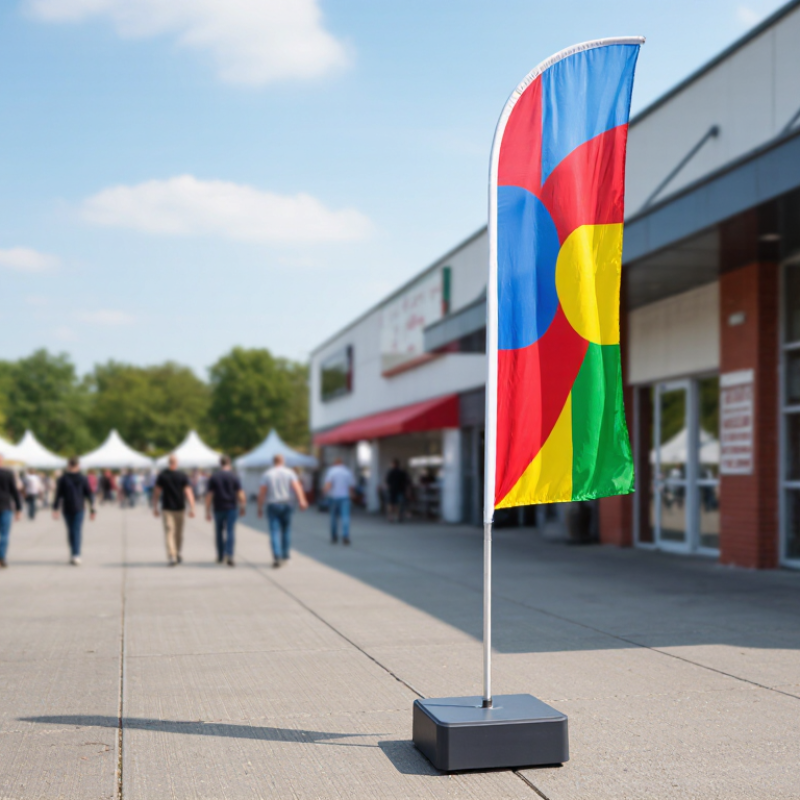
An advertising flag pole is a freestanding support designed to display a printed or fabric promotional flag. It usually combines a lightweight pole, a base, and a sleeve or attachment that holds the flag in place. Unlike a fixed sign, the flag moves with the breeze, making its shape and message easier to notice from nearby paths or roads. Common designs include straight poles and curved, feather-shaped styles. The pole may be made from aluminum or fiberglass, while the base may be filled with water or sand for added stability.

Tips: Match the pole height to the viewing distance. Check the base on the actual surface, especially outdoors. A flag that looks clear in a product photo may twist or sag in changing wind, so allow room to adjust it.

The pole is only one part of the display. Flag width, fabric weight, stitching, and attachment method affect how neatly the banner hangs. A compact setup can suit a shop entrance, market stall, or event table; taller versions can mark an approach or draw attention to a temporary display. Think about storage and transport, too. Some poles separate into sections, which is convenient, though reassembly can feel fiddly. Measure the display area before choosing a size, and inspect the assembled pole for loose joints before use.

What Is an Advertising Flag Pole Used For?

An advertising flag pole displays flags to attract attention to storefronts, events, promotions, and other locations. The chart compares the fabric area of example flag sizes; each area is calculated from the listed width and height.

How an Advertising Flag Pole Displays a Message

An advertising flag pole turns a printed fabric panel into a message people can notice while walking or driving past. The pole holds the flag upright, while its curved or angled shape helps keep the graphic open. A breeze adds movement. On a still day, the fabric may hang closer to the pole, so the design should remain readable without motion.

The message works best when it is brief and placed where the eye naturally lands. A large headline, clear contrast, and one strong image usually read faster than several lines of small text. Keep important words away from seams and tight folds. Some flags show artwork on one side; others use layered fabric for visibility from both sides. Check the print and construction before ordering, since appearance can vary by material and viewing angle.

Placement matters, too. Set the pole where people have a clear view, not behind a doorway, planter, or queue. Leave enough room for the fabric to move without catching on nearby objects. Small details are easy to miss. A flag can attract attention but cannot explain a complicated offer in a few seconds. Even a carefully designed display may twist in gusty conditions or look flat indoors; that limitation deserves attention during planning.

Where Advertising Flag Poles Are Commonly Used

Advertising flag poles are commonly placed outside retail stores, shopping centers, and car dealerships. A tall, moving flag can catch the eye near an entrance, a sale display, or a row of vehicles. The U.S. Census Bureau reported that e-commerce accounted for 16.1% of U.S. retail sales in 2024. That leaves most retail sales in physical settings, where clear on-site signs can help visitors find a business or entrance. Visibility is the point. But placement matters: flags should not block doors, signs, or drivers’ sightlines.

They also appear at trade shows, sports grounds, campuses, and community events. At a busy event, a flag can mark registration, guide people toward a booth, or make a temporary stand easier to spot. The Outdoor Advertising Association of America reported $9.1 billion in U.S. out-of-home advertising revenue for 2023, showing continued investment in advertising seen beyond the screen. That figure covers many formats, not flag poles alone. A flag is not a traffic plan. Check wind exposure, choose a stable base, and keep the message brief enough to read while walking. Sometimes the less polished setup works better; sometimes it simply looks untidy. Placement still matters.

Common Designs and Mounting Options

Advertising flag poles hold lightweight printed flags where people can see them from a distance. Feather designs have a curved top and a tapered profile, so they remain readable along sidewalks or outside storefronts. Teardrop flags use a tighter shape that can keep fabric looking neater in light, shifting air. Rectangular banners provide more room for large text, though their edges may flap more. Keep the message brief. A passing visitor rarely has time to read a paragraph.

Mounting depends on the surface and how often the display moves. A ground spike suits soft soil, while a cross base works on pavement when paired with a suitable weight. Wall brackets can position a flag beside an entrance, but the wall and fasteners need to support the expected load. For indoor events, a compact base is easier to place without damaging floors. Check clearances, too. A pole that blocks a doorway or catches overhead branches quickly becomes a nuisance. Wind changes the equation; take flags down in strong gusts and follow the pole maker’s setup guidance. I have seen displays chosen for appearance alone, then moved repeatedly because nobody checked the site first. Measure twice. That small step is easy to skip.

Factors to Consider When Choosing a Flag Pole

An advertising flag pole holds a printed flag where passing people can see it, such as outside a shop, at an event, or beside a roadside entrance. Its height and movement help a message stand out, but the pole must suit the location. A tall flag can catch attention in an open space. Near a low awning, it may look cramped or become difficult to manage.

When choosing a flag pole, consider the flag’s size, the available ground space, and typical wind conditions. A pole should support the fabric without excessive bending, while its base must stay stable on the surface. Ground spikes can work on firm soil; flat bases are more practical on pavement. Check how the pole connects to its base, too. A loose fit can cause wobbling, especially when the flag pulls in gusts. Material affects weight, durability, and upkeep. Lightweight poles are easier to carry, though they may need more careful handling. There is no perfect choice. People often focus on height and overlook storage or setup time.

Tips: Measure the display area before ordering. Test the base on the actual surface, and check the pole’s recommended flag dimensions. If wind varies at your site, choose a setup that can be lowered or moved safely. One detail is easy to miss: a flag that looks clear from nearby may be hard to read from across the street.