

Scroll Top
4801 Bennett Rd. Toledo, Ohio 43612

Top Double Stainless Steel Sink Suppliers Worldwide

The global demand for durable kitchen fixtures is creating stronger interest in Sink Double Stainless Steel products. Allied Market Research valued the global kitchen sinks market at approximately USD 3.7 billion in 2021. Its report projects the market to exceed USD 5.5 billion by 2031. Stainless steel remains attractive because it resists corrosion, tolerates heat, and supports demanding commercial use.

Material choice still requires careful judgment. Professor Michael F. Ashby, a respected materials-selection expert, wrote, “Materials selection is a process of matching material properties to the functional requirements of a design.” That principle matters when comparing worldwide suppliers. A sink may look identical online, yet differ in steel grade, thickness, welding quality, drainage design, and sound insulation. Type 304 stainless steel suits most kitchens. Type 316 may offer stronger resistance in coastal or chemically demanding environments.

Industry reports from Grand View Research and Fortune Business Insights also connect market growth with renovation activity, hospitality construction, and consumer demand for hygienic surfaces. However, reports are not purchasing guarantees. A polished catalog can still hide inconsistent tolerances or weak after-sales support. That is the uncomfortable part.

This guide examines leading Sink Double Stainless Steel suppliers worldwide through practical criteria. These include manufacturing experience, certifications, production capacity, customization, export performance, and quality control. Samples matter. So do factory audits and test records. The best supplier is not always the largest. Sometimes, a smaller manufacturer communicates better and corrects problems faster. That deserves more attention than glossy product photography.
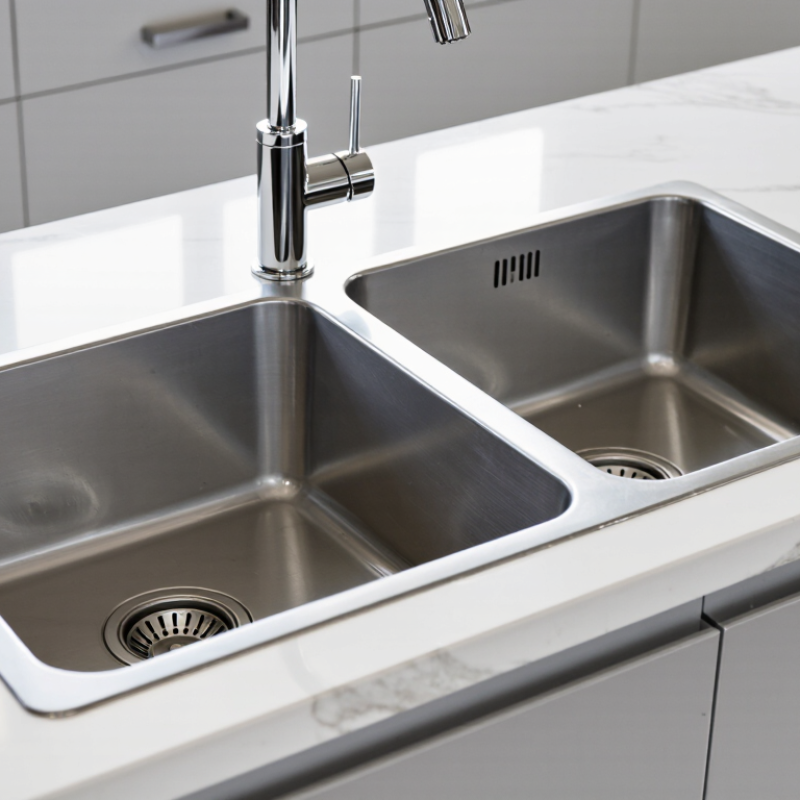
Top Double Stainless Steel Sink Suppliers Worldwide

Global Market Overview of Double Stainless Steel Sink Suppliers

Top Double Stainless Steel Sink Suppliers Worldwide

The global market for double stainless steel sinks is expanding with residential construction, renovation, and commercial food-service demand. According to Mordor Intelligence, the broader kitchen sink market is projected to grow from about USD 3.4 billion in 2024 to nearly USD 4.5 billion by 2029. Growth is not evenly distributed. Asia-Pacific remains a major manufacturing and consumption center, while Europe and North America emphasize replacement demand, hygiene, and premium installation standards.

Suppliers compete through material quality, production scale, and delivery reliability. Most double sinks use 304 stainless steel, which offers strong corrosion resistance for everyday kitchens. Coastal projects may require higher corrosion protection. Common specifications include 16- to 18-gauge steel, sound-absorbing pads, brushed surfaces, and bowl depths near 200 millimeters. Details matter. A sink can look identical online but differ in weld quality, drainage slope, and edge flatness.

Industry forecasts vary. Grand View Research identifies construction activity and modular kitchens as important growth drivers, yet market estimates use different product definitions. This makes direct supplier comparisons difficult. Buyers should request test reports, production photos, inspection records, and packaging details before placing large orders. Factory experience matters too. A capable supplier should explain how it controls polishing marks, dimensional tolerance, and water leakage. Some suppliers still rely heavily on visual inspection. That is a weakness. Third-party checks can reduce costly surprises, although they cannot replace careful specification review.

Key Criteria for Evaluating International Sink Manufacturers

Top Double Stainless Steel Sink Suppliers Worldwide

International sink manufacturers should be judged beyond product photographs and factory promises. Start with material verification. Ask for mill certificates confirming 304 or 316 stainless steel, rather than accepting vague “premium steel” claims. Check sheet thickness, basin depth, welding quality, and surface consistency. A durable double sink should resist stains, vibration, and daily temperature changes. Small details matter.

Factory experience is equally important. Review production records, export markets, quality-control procedures, and independent test reports. Inspect how corners are formed and polished. Rough welds can trap food particles and create cleaning problems. Confirm drainage performance with practical water-flow tests. Request samples before placing a large order. One sample is useful, but it may not represent every batch.

Reliability also depends on communication. Evaluate response times, technical drawings, packaging methods, spare-part support, and realistic lead times. Ask how damaged units are handled after delivery. Certifications should be verified through recognized testing bodies, not only copied into brochures. A polished factory tour can still hide inconsistent production. I would compare several shipments, because one successful order proves very little. Even experienced buyers sometimes overlook carton strength, causing preventable damage at the port. Clear contracts, inspection records, and traceable materials reduce that risk.

Leading Supplier Regions and Their Production Strengths

Top Double Stainless Steel Sink Suppliers Worldwide

Leading Supplier Regions and Their Production Strengths

China remains a major sourcing region for double stainless steel sinks. Its factories often combine deep drawing, laser welding, polishing, and automated inspection. Large production clusters can support high volumes and varied bowl sizes. Buyers should confirm the actual steel grade, rather than relying on catalog descriptions. Small differences in material thickness can affect noise, dent resistance, and installation stability.

India offers strong metalworking experience and flexible production for customized sink designs. Many suppliers handle handmade fabrication, visible corner welding, and detailed surface finishing. This can suit hospitality projects or residential kitchens with unusual dimensions. However, finishing consistency may vary between workshops. Sample approval and batch inspections are important.

Turkey serves buyers seeking practical access to European, Middle Eastern, and nearby African markets. Its manufacturers often focus on pressed sinks, efficient logistics, and medium-volume orders. Italy and other European regions typically emphasize precise tooling, refined surfaces, and strict process documentation. Their pricing may be higher. Vietnam is also developing capabilities in stainless fabrication and export-oriented assembly, although supplier maturity differs widely. No region leads every category. A reliable evaluation should compare 304 stainless composition, gauge, drainage design, weld quality, packaging, and production records. Factory visits help, but they do not replace independent testing. Some suppliers communicate well yet overlook small defects inside the bowl. That detail deserves attention.

Product Quality, Certifications, and Customization Options

Top Double Stainless Steel Sink Suppliers Worldwide: Product Quality, Certifications, and Customization Options

Choosing a double stainless steel sink requires more than checking its surface shine. The World Stainless Association reported approximately 58.4 million tonnes of crude stainless steel production in 2023. That scale supports stable material supply, but it does not guarantee sink quality. Buyers should verify steel grade, thickness, weld consistency, sound-deadening pads, and drain alignment. A practical inspection includes running water through both bowls and checking for standing water.

Certifications provide useful evidence. NSF/ANSI 51 addresses materials and finishes used in food equipment. EN 13310 covers functional requirements for domestic sinks, including drainage and resistance testing. Suppliers should provide current certificates, test methods, and traceable production records. A certificate without a matching factory batch is weak evidence. This detail is often overlooked.

Customization can improve installation results. Common options include bowl depth, corner radius, overflow position, mounting style, surface finish, and drain opening size. For commercial projects, suppliers may also adjust worktop dimensions and reinforcement points. However, every modification can affect tooling costs and delivery time. I would not assume a custom sink is automatically better. In practice, a precise drawing, sample approval, and dimensional inspection reduce expensive surprises, although minor errors can still occur during mass production.

Top Double Stainless Steel Sink Suppliers Worldwide - Product Quality, Certifications, and Customization Options

Supplier Profile Primary Manufacturing Region Typical Product Focus Common Stainless Steel Grades Typical Material Thickness Quality and Performance Features Relevant Certifications or Standards Customization Options Typical MOQ Range Indicative Production Lead Time
Large-Scale Export Manufacturer East and Southeast Asia Standard double-bowl kitchen sinks for retail and project orders AISI 304; AISI 201 available for value-oriented models 0.8–1.2 mm for the sink body; heavier gauges available Deep-drawing construction, sound-absorbing pads, anti-condensation coating, brushed or satin finish ISO 9001 manufacturing systems; EN 13310 testing may be requested for applicable models Bowl size, drain position, tap-hole layout, overflow design, surface finish, packaging, and private labeling 100–500 pieces per model 30–60 days after artwork and specification approval
Premium Fabrication Specialist Western and Central Europe High-end handmade and welded double-bowl sinks AISI 304; AISI 316L for specialized corrosion-resistance requirements 1.0–1.5 mm, depending on bowl size and installation method Precisely welded corners, reinforced mounting rails, low-noise pads, uniform grain direction, hand-polished edges CE-related documentation where applicable; EN 13310 performance requirements; ISO 9001 commonly available Made-to-measure dimensions, radius corners, custom drain locations, integrated accessories, laser engraving, and special finishes 10–50 pieces per design 45–75 days for custom or low-volume projects
Private-Label OEM/ODM Supplier China and Vietnam Retail-ready double sinks developed for distributors and e-commerce brands AISI 304 is standard for mid-to-premium ranges 0.7–1.2 mm; 1.5 mm options available for premium series Machine-pressed or handmade bowls, PVD finishes, anti-scratch treatments, protective undercoating, and customized packaging ISO 9001 commonly available; material composition reports and factory inspection records can be requested Logo, carton design, barcode labels, product inserts, accessories, finish, bowl ratio, and installation templates 300–1,000 pieces per SKU 35–65 days, excluding tooling and sample approval
Commercial Project Supplier North America and Mexico Durable double-bowl sinks for residential developments, hospitality, and renovation projects AISI 304; 18-gauge and 16-gauge options are common in heavy-duty ranges 1.2–1.6 mm for commercial-grade configurations Reinforced underside, tighter dimensional control, sound-dampening pads, compatible mounting clips, and replacement-part support NSF/ANSI 2 may apply to commercial food-service products; ASTM test methods may be used for material and performance evaluation Project-specific dimensions, mounting type, drain configuration, accessories, packaging, and delivery scheduling 50–250 pieces per project specification 30–55 days, subject to project volume and logistics
Flexible Small-Batch Manufacturer South Asia and Türkiye Small and medium runs of sinks for regional distributors and custom kitchen studios AISI 304; AISI 430 for selected non-critical components 0.8–1.2 mm, with custom gauge selection available Hand-finished surfaces, welded or pressed bowls, basic sound insulation, and flexible dimensional options Material certificates, salt-spray or corrosion reports, and quality inspection records should be confirmed per order Dimensions, bowl configuration, drainboard, tap holes, surface texture, packaging, and accessory bundles 50–200 pieces per model 25–50 days after final approval
Sustainable Manufacturing Supplier Australia, New Zealand, and selected Asian facilities Recycled-content stainless steel sinks for environmentally focused construction and retail programs AISI 304 with documented recycled content where specified 0.8–1.2 mm for standard double-bowl models Recyclable stainless steel construction, water-based protective coatings where available, reduced-plastic packaging, and repairable components ISO 14001 may be available for environmental management; recycled-content claims should be supported by chain-of-custody documentation Recycled-content percentage, packaging materials, dimensions, finish, drain position, accessories, and sustainability documentation 100–500 pieces per model 40–70 days, depending on material sourcing and documentation requirements

Note: Specifications, certifications, minimum order quantities, and lead times vary by manufacturer and product configuration. Buyers should request current material certificates, inspection reports, and certification documents before placing an order.

How to Select a Reliable Double Stainless Steel Sink Supplier

Top Double Stainless Steel Sink Suppliers Worldwide

Selecting a reliable double stainless steel sink supplier requires more than comparing online prices. Material evidence matters. Ask for the steel grade, thickness, and surface treatment in writing. Food-grade applications commonly require corrosion-resistant stainless steel, such as 304 or suitable alternatives. However, a grade label alone proves little. Request traceable mill certificates and independent test reports.

Study the sink’s construction closely. Inspect welds around the bowls, corners, and drain openings. Uneven polishing may collect dirt and reveal weak quality control. Ask for production samples before approving a large order. Check bowl depth, sound-absorbing pads, mounting hardware, and drainage performance. Small details become expensive problems during installation.

A dependable supplier should explain lead times, packaging methods, inspection procedures, and replacement policies clearly. Visit the factory when possible, or arrange a documented third-party audit. Review recent customer references from similar projects. Communication speed is useful, but honest answers matter more. I have seen attractive catalogs hide inconsistent dimensions. That warning deserves attention. Request a pre-shipment inspection with photographs, measurements, and carton checks. Payment terms should match verified production milestones, not vague promises. A supplier may still make mistakes. What matters is whether the team records them, corrects them, and improves the next batch.

Top Double Stainless Steel Sink Suppliers Worldwide - How to Select a Reliable Double Stainless Steel Sink Supplier

Compare the minimum specified chromium and nickel content of commonly used stainless steel grades. When evaluating suppliers, request material certificates and confirm that the supplied grade matches the contract specification.

304 stainless steel is widely used for general kitchen applications, while 316 offers improved resistance in chloride-rich environments because it contains molybdenum. 430 is a lower-nickel ferritic grade. A reliable supplier should provide traceable test reports, consistent grade identification, dimensional inspection records, and clear quality-control documentation.