

Scroll Top
4801 Bennett Rd. Toledo, Ohio 43612

China Top 10 Sugar Storage Jar Suppliers for Global Buyers

Choosing a reliable Sugar Storage Jar supplier requires more than comparing catalog photos and quoted prices. Global buyers must examine glass quality, lid construction, gasket performance, food-contact documentation, and production consistency. A jar may look elegant on a screen, yet fail when sugar meets humidity, repeated opening, or rough international transport.

Dr. Ted Labuza, a respected food-packaging scientist, emphasized a practical principle: “The package is a critical component of the food system.” That idea remains highly relevant here. A well-designed Sugar Storage Jar should protect texture, reduce moisture exposure, support hygienic handling, and remain comfortable during daily use. Small details matter. A silicone seal that feels loose can become a serious weakness.

This guide reviews ten China-based suppliers serving international buyers. It considers manufacturing experience, material options, customization, quality controls, minimum order quantities, and export support. Some suppliers may excel at premium glassware, while others may offer stronger pricing for hospitality or retail programs. No supplier is perfect.

Buyers should request samples before approving large orders. They should also verify test reports, closure compatibility, carton protection, and labeling requirements for the destination market. Supplier claims deserve careful checking. Even experienced buyers can overlook condensation, chipped rims, or inconsistent lid threading.

The ranking is therefore a practical starting point, not a permanent verdict. Market conditions change. Production teams change. Careful evaluation still matters.
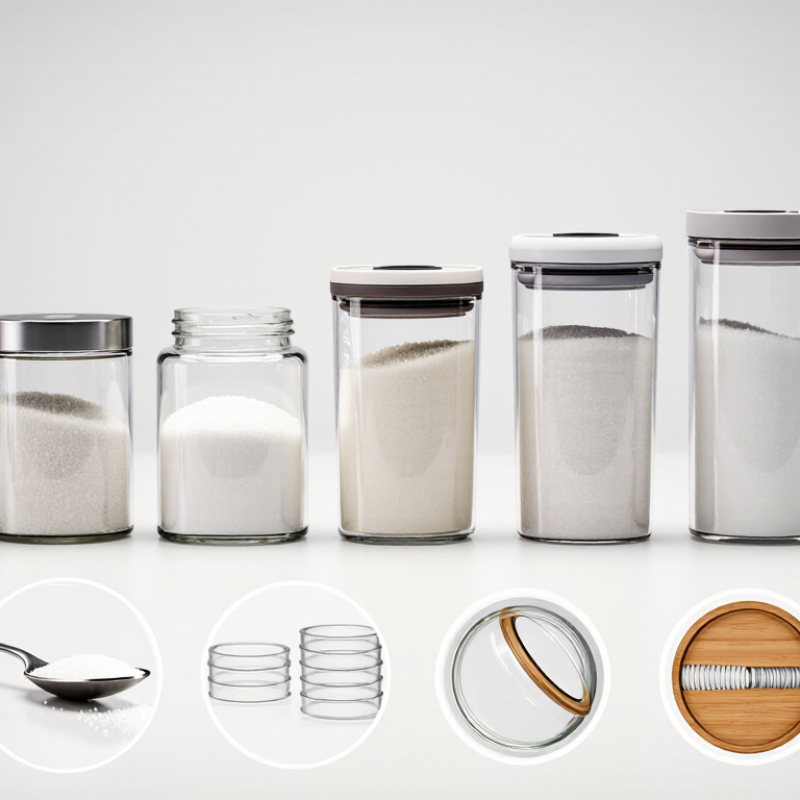
China Top 10 Sugar Storage Jar Suppliers for Global Buyers

What Defines a Reliable Sugar Storage Jar Supplier in China

China’s top sugar storage jar suppliers should prove reliability beyond attractive catalogs and low quotations. A dependable supplier explains material grades, production capacity, and quality controls in clear terms. For glass jars, request food-contact documentation, wall-thickness data, and closure specifications. The lid should fit firmly, without excessive force. Silicone seals need checking for odor, flexibility, and repeated-use performance. Small details matter.

Ask for a production sample before placing a large order. Test it with sugar, moisture, and ordinary kitchen handling. A simple drop test can reveal weak glass or loose lids. Reliable factories should provide batch records, inspection photos, and consistent packaging details. They should also communicate realistic lead times, rather than promising everything immediately. That is not always comfortable.

Tips: Compare at least three suppliers using the same checklist. Visit the factory when possible, or arrange an independent inspection. Check carton strength, inner protection, labeling, and pallet loading. Confirm whether replacement parts are available. A supplier may pass one inspection and still disappoint later, so keep written quality standards in the purchase agreement. Ask difficult questions early. Silence is a warning sign. Even experienced buyers can overlook seasonal capacity changes, manual assembly errors, or unclear responsibility after delivery. Reliable cooperation depends on evidence, repeatable processes, and honest correction when a problem appears.

How the Top 10 Chinese Suppliers Compare by Product Range

China’s top ten sugar storage jar suppliers vary mainly in product range, not basic function. Most offer clear glass jars with bamboo, metal, or plastic lids. Some focus on compact kitchen sizes. Others produce larger pantry containers for restaurants and food-service buyers. Several also provide matching sets, spice jars, flour canisters, and countertop organizers.

A wider product range can simplify purchasing, especially when buyers need one visual style across several capacities. Look for suppliers offering 300 ml, 500 ml, 1,000 ml, and larger options. Lid design matters too. Silicone seals support daily freshness, while screw lids may reduce unit costs. Some suppliers provide embossed logos, printed labels, or custom colors. However, customization often increases minimum order quantities and production time.

Experienced buyers should request samples before approving a bulk order. Check the jar’s weight, rim smoothness, seal fit, and resistance to minor impact. Ask for food-contact documentation and factory quality records. Product photos can hide uneven glass thickness. I have seen attractive samples fail during transport tests. That gap deserves attention. Suppliers with broader ranges are not always more reliable. Compare sample consistency, packaging strength, replacement policies, and communication speed. The strongest option is usually the supplier whose range matches your shelves, target price, and shipping conditions.

China Top 10 Sugar Storage Jar Suppliers for Global Buyers - How the Top 10 Chinese Suppliers Compare by Product Range

Supplier Profile Main Product Range Typical Materials Common Capacities Lid and Seal Options Customization Typical MOQ Best Fit for Buyers
Supplier Profile 01 Glass sugar jars, spice jars, flour jars, and countertop canisters Soda-lime glass, stainless steel, bamboo 500 ml–2,000 ml Clamp lids, screw lids, silicone gasket seals High 500–1,000 pcs Retail and private-label programs
Supplier Profile 02 Ceramic sugar jars, tea canisters, coffee containers, and matching kitchen sets Ceramic, porcelain, acacia wood 300 ml–1,500 ml Wooden lids, ceramic lids, silicone-lined covers High 1,000–2,000 pcs Lifestyle, gift, and homeware collections
Supplier Profile 03 Stainless-steel sugar jars, flour bins, utensil holders, and pantry containers Stainless steel, glass, food-grade silicone 700 ml–3,000 ml Press-fit lids, roll-top lids, airtight silicone seals Medium 1,000–3,000 pcs Commercial kitchens and durable-use products
Supplier Profile 04 Plastic sugar containers, modular pantry boxes, and stackable storage jars PP, PET, Tritan-style copolyester, silicone 500 ml–5,000 ml Snap-lock lids, four-sided locking lids, pour spouts High 2,000–5,000 pcs Volume retail and value-focused ranges
Supplier Profile 05 Bamboo-lid glass jars, eco kitchen sets, and refill-store containers Glass, bamboo, cork, silicone 400 ml–1,800 ml Bamboo screw lids, cork stoppers, gasket seals High 500–1,500 pcs Eco-conscious and sustainable packaging buyers
Supplier Profile 06 Decorative ceramic jars, embossed canisters, and hotel tabletop containers Stoneware, porcelain, stainless steel 250 ml–1,200 ml Ceramic covers, metal lids, silicone gaskets High 1,000–3,000 pcs Premium hospitality and decorative collections
Supplier Profile 07 Large-capacity glass jars, pantry dispensers, and bulk food storage containers Thick soda-lime glass, stainless steel, silicone 1,000 ml–5,000 ml Clamp lids, wide-mouth screw lids, airtight rings Medium 500–1,500 pcs Restaurants, bakeries, and bulk-storage users
Supplier Profile 08 Small glass jars, sample containers, condiment jars, and gift packaging Glass, tinplate, bamboo, silicone 100 ml–800 ml Metal screw lids, twist-off lids, inner seals High 1,000–5,000 pcs Promotional, gift, and specialty food packaging
Supplier Profile 09 Modern acrylic and plastic canisters, drawer organizers, and modular sets PET, PP, acrylic, silicone 300 ml–3,000 ml Flip-top lids, sliding lids, airtight locking covers High 2,000–5,000 pcs Contemporary home organization retailers
Supplier Profile 10 Mixed-material sugar jars, complete pantry collections, and custom kitchen programs Glass, ceramic, stainless steel, bamboo, silicone 250 ml–3,000 ml Clamp, screw, snap-lock, and magnetic lid systems Very High 500–2,000 pcs International buyers needing broad product coverage
Product specifications, minimum order quantities, material availability, and customization terms should be confirmed directly with the selected manufacturer before ordering.

Key Materials, Designs, and Customization Options

For global buyers comparing China’s top sugar storage jar suppliers, material choice should come before decoration. The Smithers report, The Future of Global Packaging to 2028, values the global packaging market at more than 1 trillion US dollars, showing the scale behind material decisions. Borosilicate glass handles heat changes well and keeps sugar visible. Food-grade polypropylene reduces weight and shipping risk. Silicone gaskets improve moisture resistance, but their compression must be tested over time.

Design affects daily use more than catalog photos suggest. A wide 10-centimeter opening allows a spoon to enter without spilling crystals. A square body uses cabinet space efficiently, while a rounded shoulder cleans more easily. Buyers should request drop tests, odor checks, dishwasher-cycle tests, and migration documentation. The European Commission’s food-contact materials framework requires materials to avoid transferring harmful substances into food. Compliance paperwork matters.

Customization can include embossed logos, printed measurement marks, lid colors, bamboo covers, and retail gift boxes. However, darker coatings may scratch during transport. That detail is easy to miss. According to Grand View Research, the global glass packaging market was valued at about 75 billion US dollars in 2023, supporting continued investment in glass production and finishing. Suppliers should provide sample jars before bulk orders. One sample is not enough. Test several batches, because seal fit, print alignment, and glass thickness can vary slightly.

Quality Standards, Pricing, and Minimum Order Requirements

Selecting among China’s top ten sugar storage jar suppliers requires more than comparing catalog photos. Global buyers should request food-contact declarations, batch test reports, and material details for every component. For glass jars, inspect lead and cadmium migration results, wall thickness, lid fit, and thermal-shock performance. Plastic options need resin identification, odor testing, and evidence of compliance with destination-market requirements. Ask for samples first. A clean surface can still hide a poorly sealed lid.

Pricing depends on material, capacity, decoration, packaging, and order volume. Plain glass jars may cost roughly $0.45 to $1.80 per unit at factory level. Custom colors, bamboo lids, embossing, or printed labels increase the unit price. Standard stock items often start around 500 to 1,000 units. Custom molds may require 3,000 to 10,000 units. Confirm whether the minimum order applies per color, lid style, or design. Request separate tooling, sample, packaging, and shipping charges. Otherwise, the “low” quotation may be incomplete.

Reliable suppliers should explain inspection procedures, carton protection, production schedules, and replacement terms for damaged goods. Factory audits and pre-shipment inspections add useful evidence, especially for large retail orders. Communication quality matters. Slow answers can become costly delays. One weakness in many sourcing plans is trusting certificates without checking their issue date or test scope. Buyers should compare the report with the exact jar, lid, and coating ordered. Include carton drop tests and humidity checks before approving mass production. Small details often decide whether shelves receive a dependable product or an expensive rework.

How Global Buyers Can Evaluate and Source the Right Supplier

China Top 10 Sugar Storage Jar Suppliers for Global Buyers

Selecting a supplier requires more than comparing catalog prices. Global buyers should examine factory experience, product materials, and quality controls. Ask how long the supplier has produced sugar storage jars. Request factory photos, production records, and recent inspection examples. A polished catalog is not proof.

Order samples before discussing large quantities. Check the lid seal, glass clarity, edge finishing, and label space by hand. Fill the jar with sugar and test it near a humid kitchen window. Small defects become obvious there. Confirm food-contact materials and request relevant test documents for your destination market. Requirements can differ between countries, so buyers should verify them independently.

A reliable supplier provides clear specifications, including capacity, dimensions, weight, packaging, minimum order quantity, and lead time. Ask whether cartons use dividers and whether spare lids are available. Discuss logo printing, color variation, and replacement procedures in writing. Factory audits or third-party inspections can reduce uncertainty before shipment. Communication speed matters too, but fast replies do not always mean strong production control. I would compare at least three samples and record every difference. That step takes time. It may prevent a costly decision based only on attractive pricing.