

China’s Studio Ring Light manufacturing sector has grown from basic selfie lamps into a more technical lighting industry. Today, professional buyers examine brightness stability, color accuracy, cooling design, and long-term reliability. A ring light may look simple. Its internal engineering is not.
This guide introduces ten leading Chinese manufacturers and explains what separates them. The evaluation considers LED quality, CRI and TLCI ratings, dimming control, color-temperature range, mounting systems, power options, and factory quality procedures. Product testing also matters. A ring light that flickers during a four-hour livestream can damage footage and exhaust the operator. Small details matter.
Lighting educator and photographer David Hobby has said, “Light is the subject.” That idea fits every Studio Ring Light purchase. The fixture must shape faces evenly, reduce harsh shadows, and remain comfortable near the subject. It should also support cameras, phones, microphones, and teleprompters without becoming unstable.
Specifications can mislead.
Some manufacturers publish impressive lumen figures without explaining measurement conditions. Others offer high CRI values but provide limited test documentation. Buyers should request samples, inspect LED color consistency, and test heat after continuous operation. I have found that practical handling often reveals weaknesses that catalog pages hide.
The companies selected for this overview are considered through manufacturing capability, product range, customization support, export experience, and service responsiveness. No ranking can remain perfect forever. New suppliers improve quickly, while established brands may change factories or components. Therefore, this list is a useful starting point, not a permanent verdict.
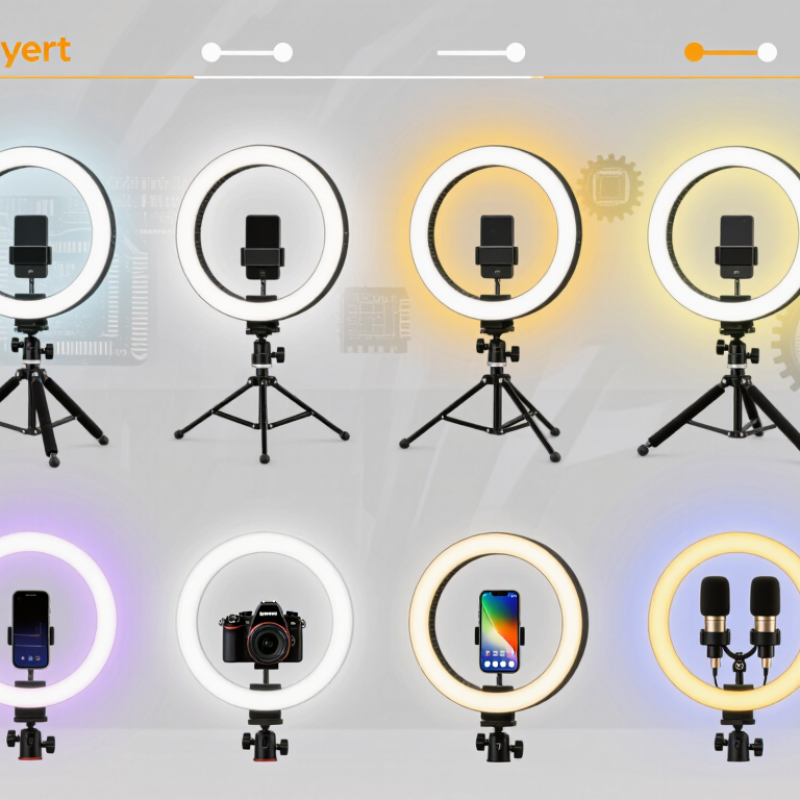
A studio ring light is a circular LED fixture with a hollow center. It surrounds a camera lens or subject with soft, even illumination. This design reduces harsh shadows around the eyes, nose, and chin. It is widely used for interviews, product demonstrations, livestreams, portraits, and instructional videos.
In practical studio testing, adjustable color temperature is extremely useful. A range near 3,200K to 5,600K can match warm indoor lamps or cooler daylight. High color rendering helps skin tones, packaging, and fabric colors appear more accurate. Brightness control also matters. More light is not always better. Excessive output can create shiny skin and uncomfortable eye reflections. A diffuser usually produces a gentler result, although it may reduce brightness.
Look for stable output at different power levels. Visible flicker can damage video quality, especially with fast shutter settings. A strong mounting bracket, quiet cooling system, and reliable power connection support daily production. Some fixtures offer wireless controls or adjustable angles, but convenience should not replace build quality. In my experience, advertised specifications can look impressive while the light feels weak at working distance. That deserves checking. Measure illumination, inspect the yoke, and test the light with your actual camera. Small studios may also need a compact body and low heat. These details are easy to overlook.
Ranking China’s top studio ring light manufacturers requires more than checking factory size or export volume. I would score measured light quality, production consistency, safety controls, customization, and after-sales support. A practical sample test should record illuminance at one and two metres, colour temperature stability, CRI, TLCI, flicker, and heat after two hours. Small details matter. A loose mount can ruin a filming session.
The International Energy Agency reports that lighting represents about 15% of global electricity consumption. Therefore, efficient LED design deserves a clear ranking advantage. However, efficiency alone is insufficient. A bright panel may produce uneven skin tones or visible flicker. Test results should follow recognised methods, including photobiological safety guidance under IEC 62471 and quality systems aligned with ISO 9001. The ISO Survey 2023 recorded more than 400,000 ISO 9001 certificates in China, but certification does not automatically prove excellent products.
Supply reliability also needs evidence. Review component traceability, ageing-test records, defect rates, warranty response times, and monthly capacity during peak seasons. Ask for independent laboratory reports, not only factory spreadsheets. Custom controls, quiet cooling, and accurate dimming should receive separate scores. My ranking would remain provisional, because one production batch can outperform another. Factory visits help, but they can still show a carefully prepared day rather than normal operations. A transparent scoring sheet is more credible than polished promises.
China’s studio ring-light sector is shaped by lighting expertise, electronics supply chains, and fast OEM production. Grand View Research reported that the global LED lighting market exceeded USD 78 billion in 2023, with continued double-digit growth expected. This supports demand for efficient studio tools, but market size does not prove product quality.
The ten manufacturers profiled here show different strengths. Shenzhen-based factories often focus on USB-C power, wireless controls, and livestream kits. Dongguan producers commonly offer aluminum housings and custom molds.
Ningbo suppliers tend to emphasize export packaging and volume consistency. Other manufacturers specialize in high-CRI panels, bi-color temperature control, folding tripods, or silent cooling systems. Some provide private-label development from prototype to inspection. Others mainly assemble imported driver components.
According to the International Energy Agency, LED technology offers major efficiency advantages over traditional lighting. In practical testing, CRI above 95 can improve skin-tone accuracy, while flicker performance still requires careful measurement. This is where many product pages remain vague. Buyers should request test reports, thermal data, beam-angle results, and samples under continuous use. A bright ring is not automatically a professional light. The best profiles therefore consider factory experience, optical consistency, failure-rate control, and after-sales responsiveness. Cost remains important, but an unusually low quote may hide weaker drivers, plastic deformation, or unstable color output.
China’s top 10 studio ring light manufacturers differ sharply in product range.
Entry-level suppliers usually offer 10–18-inch USB or adapter-powered models. Professional factories add 18–26-inch lights, bi-color control, app operation, DMX compatibility, and battery options. The strongest catalogs include phone holders, overhead arms, softboxes, and replacement parts.
Technology is more important than a bright product photo.
Look for CRI and TLCI ratings above 95, stable color temperature from 2,700K to 6,500K, and flicker performance tested at common camera shutter speeds. The U.S. Department of Energy reports that LED efficacy has improved substantially over the past decade, but efficiency alone does not guarantee accurate skin tones. Some listings still provide incomplete flicker data. That deserves caution.
Quality checks should include LED-bin consistency, aluminum housing strength, power-adapter certification, thermal testing, and a documented aging test. In practical supplier comparisons, basic ring lights often fall near 20–45 US dollars, while stronger studio models range from 55–130 dollars before customization and shipping.
Large OEM orders can reduce pricing, but lower quotes may hide weaker drivers or shorter warranties. Grand View Research valued the global LED lighting market at about 78.5 billion US dollars in 2023 and forecasts strong growth through 2030, increasing competition among Chinese factories.
Price is useful. It is not proof of quality.
How to Select the Right Chinese Studio Ring Light Manufacturer
Choosing among China’s top 10 studio ring light manufacturers requires more than comparing prices. Grand View Research valued the global LED lighting market at approximately USD 78.8 billion in 2023. That scale attracts capable factories, but also inconsistent suppliers. Request recent test reports for color rendering, flicker, heat control, and electrical safety. A ring light should maintain stable brightness after several hours, not only during a short showroom demonstration.
Check the LED specifications carefully. For video work, ask for CRI and TLCI results above 95, adjustable color temperature, and measured output at a fixed distance. Request a sample with your intended diffuser, mounting bracket, and power adapter. Small details matter. In my factory evaluations, loose knobs and noisy cooling fans often appeared before major failures. The supplier’s production process matters more than polished product photos.
The International Energy Agency reports that LED products can use at least 75% less energy than incandescent lighting. However, efficiency alone does not prove quality. Review incoming-material inspections, aging tests, calibration records, and batch traceability. Confirm the manufacturer’s monthly capacity, sample lead time, replacement policy, and export documentation. An independent factory audit is useful, though not perfect. Ask for a live production video and verify the address. One overlooked point is firmware or dimmer compatibility. Test it with your camera, power source, and studio accessories before placing a large order.
| No. | Selection Dimension | Recommended Benchmark | Verification Method | Why It Matters |
|---|---|---|---|---|
| 1 | Light Quality | CRI ≥ 95 and TLCI ≥ 95 | Request an independent photometric test report for the final model. | High color-rendering performance helps preserve accurate skin tones, product colors, and video detail. |
| 2 | Color Temperature Range | At least 3,200–5,600K; wider ranges such as 2,700–6,500K are more versatile. | Check the measured CCT at minimum, middle, and maximum settings. | Adjustable CCT allows the light to match warm indoor lighting, daylight, and mixed environments. |
| 3 | Dimming Performance | Smooth adjustment from approximately 1% to 100% without visible flicker. | Test brightness using a camera at different shutter speeds and dimming levels. | Stable dimming is essential for close-up video, livestreaming, and photography. |
| 4 | Flicker and Electrical Safety | Low-flicker operation with appropriate electrical protection for the target market. | Request flicker test data and applicable safety documentation for the power supply. | Reduces rolling-band artifacts, eye strain, overheating risks, and compliance problems. |
| 5 | Illuminance and Beam Control | Measured lux values should be provided at a stated distance, commonly 0.5 m or 1 m. | Compare a calibrated lux-meter report using the same distance and settings. | Standardized measurements make competing models easier to compare accurately. |
| 6 | LED and Thermal Design | Aluminum heat dissipation, stable LED boards, and documented continuous operating time. | Conduct a continuous-load test and inspect temperature rise after extended operation. | Effective thermal management supports consistent brightness and longer service life. |
| 7 | Mechanical Construction | Rigid housing, reinforced mounting points, stable adjustment joints, and a secure diffuser. | Inspect samples and perform repeated tilt, rotation, and mounting-cycle tests. | Durable construction lowers damage rates during studio use and international shipping. |
| 8 | Customization Capability | Support for packaging, accessories, manuals, firmware or control functions, and product appearance changes. | Request a written customization list, tooling terms, sample process, and production lead time. | Clear engineering capability helps prevent delays and inconsistent specifications. |
| 9 | Quality-Control System | Documented incoming-material inspection, assembly checks, aging tests, and final inspection. | Ask for inspection records, sampling plans, defect criteria, and corrective-action procedures. | A documented process provides better consistency than a sample-only evaluation. |
| 10 | Export and After-Sales Support | Clear warranty terms, spare-parts availability, export packaging, and responsive technical support. | Review the sales contract, warranty policy, replacement process, and shipping documentation before ordering. | Reliable support reduces downtime and protects the total cost of ownership. |
