

Scroll Top
4801 Bennett Rd. Toledo, Ohio 43612

What Are the Different Types of Kitchen Faucets?

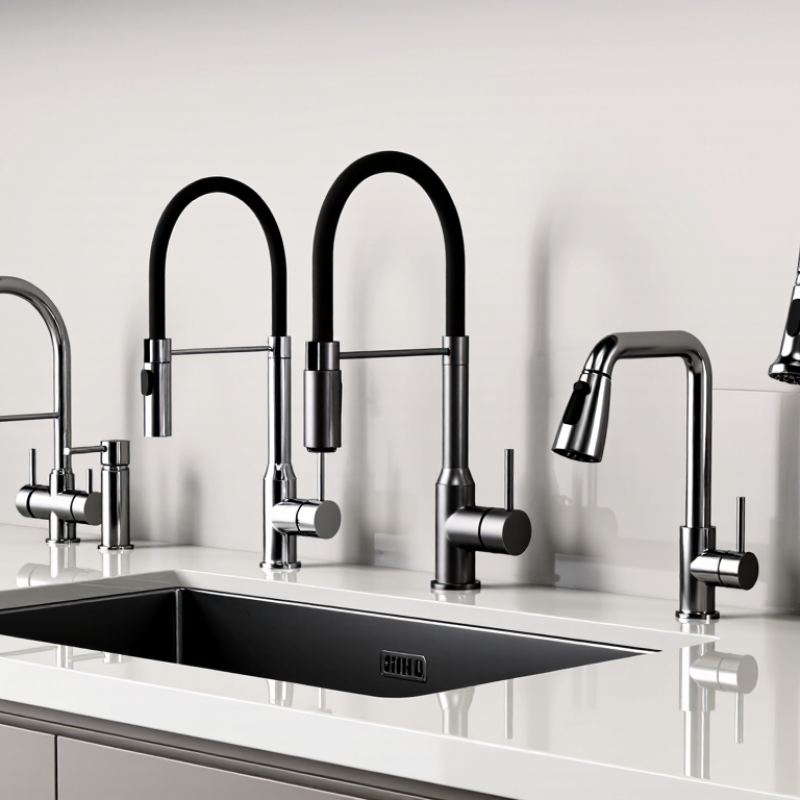
Kitchen Faucets do more than deliver water. Their design affects everyday tasks, from rinsing leafy greens to filling a tall stockpot. The right choice depends on your sink, counter space, plumbing, and routine—not just appearance. A high-arc spout can make room for large cookware, while a compact faucet may suit a shallow sink better.

Common options include single-handle and two-handle models, pull-down and pull-out sprayers, touchless designs, bridge faucets, and wall-mounted styles. Each has practical trade-offs. A pull-down sprayer can reach across a deep basin, but its hose and weight should return smoothly after use. Touchless controls can help when hands are messy, though batteries or power connections need consideration. Small details matter. Spout reach matters, too.

This guide explains how the main faucet types work and where each may fit best. It also considers installation needs, cleaning, and features that can affect daily use. Product specifications are useful, but they do not always show how a faucet feels in a particular kitchen. Measure your sink and check your connections before choosing. There is no universally perfect model; even a well-reviewed faucet may feel awkward if its reach or handle placement clashes with your setup. A careful comparison can help you find a reliable fit without paying for features you will rarely use.
What Are the Different Types of Kitchen Faucets?

Kitchen Faucet Types by Mounting Style

Kitchen Faucet Types by Mounting Style

Deck-mounted faucets attach directly to the sink or countertop. They are common because supply lines usually connect beneath the basin, where they remain accessible for repairs. A single-hole model needs one opening; other designs may require separate holes for handles or a side sprayer. Check the sink’s hole spacing before buying. A faucet can look right in a photo and still fail to fit.

Wall-mounted faucets connect through plumbing inside the wall, leaving more counter space open. That gap makes wiping crumbs and water easier, but installation depends on pipe placement and finished-wall height. The spout must reach far enough into the basin to limit splashing. Small detail, big consequence. If you are replacing an existing faucet, a deck-mounted style is often simpler when the holes already match. A wall-mounted upgrade may require opening the wall, so confirm the rough-in measurements before choosing. I would not assume every sink can accommodate either style; even a small mismatch can mean extra work or an awkward stream of water.

Kitchen Faucet Types by Spout Design

Kitchen faucet spouts shape both the look of a sink and the space available for daily tasks. A high-arc, or gooseneck, spout leaves room for tall pots and makes it easier to rinse bulky cookware. Its extra height can also send water splashing into a shallow sink, especially at high pressure. Check the distance from the spout outlet to the basin before choosing one.

A low-arc spout sits closer to the sink, creating a compact profile that often suits smaller kitchens or shallow windowsills. It can limit clearance for filling large stockpots, though. Straight spouts offer a simple, direct reach, but their usefulness depends on where the water lands. A spout that falls near the basin’s edge may splash more than one aimed toward the center. Small details matter.

Pull-down and pull-out faucets add a movable spray head to the spout. Pull-down designs usually pair with taller, curved spouts, while pull-out models often use a shorter, more forward-reaching shape. The hose helps rinse sink corners and wash produce, but it needs enough room to retract smoothly beneath the sink. Measure the cabinet space, and consider how often you handle large cookware. A dramatic curve may look appealing; it is not always the easiest fit.

Kitchen Faucet Types by Handle Configuration

A single-handle faucet uses one lever to control temperature and flow. Move it sideways for warmth, then lift it to fill a pot. It is quick with wet hands and leaves more counter space clear. The trade-off is precision: small lever movements can shift the temperature noticeably. Two-handle faucets separate hot and cold controls. Their familiar knobs can make fine adjustments easier, but they take both hands and more reach. One lever. Two controls. Neither is automatically better; try the motion before choosing.

For tighter installations, a wall-mounted faucet may use one or two handles, but its valve placement must match the plumbing inside the wall. That detail is easy to overlook. The U.S. Department of Energy sets a 2.2-gallon-per-minute maximum flow rate for standard kitchen faucets at 60 psi; handle style does not change that limit. The EPA’s WaterSense specification sets a 1.5-gallon-per-minute limit for labeled bathroom faucets, a useful comparison but not a kitchen-faucet rating. These figures come from different product categories, so they should not be treated as interchangeable. Check the faucet’s installation requirements, reach, and temperature-control feel together—not just the handle count.

Kitchen Faucet Types by Water-Control Mechanism

Kitchen Faucet Types by Water-Control Mechanism

Compression faucets use separate hot and cold handles. Turning a handle presses a rubber washer against a valve seat to stop water. The parts are simple, but worn washers can cause drips. You may need to turn the handles firmly. That is not always convenient with wet hands.

Ball faucets usually have one handle and a rotating ball that controls flow and temperature. Cartridge faucets also use a handle to move an internal cartridge; some have one handle, others two. Ceramic-disc faucets use two flat ceramic plates to regulate water, often with a short quarter-turn. These designs can feel similar from above. The distinction can feel annoyingly technical, so check the product’s mechanism rather than relying on handle count alone.

Small parts matter. A persistent drip can waste water, whatever mechanism caused it. The U.S. Environmental Protection Agency estimates household leaks waste nearly 10,000 gallons annually per home; that figure covers leaks throughout the home, not faucets alone. When comparing faucets, look for accessible replacement cartridges, washers, or seals, and confirm the parts are available. EPA’s estimate gives useful context, but it does not prove one faucet mechanism leaks less than another. A mechanism that is easy to maintain may be the more practical choice.

Specialty Kitchen Faucets and Their Uses

What Are the Different Types of Kitchen Faucets?
Specialty Kitchen Faucets and Their Uses

Specialty faucets handle particular kitchen tasks rather than replacing the main sink faucet. A pot filler, often mounted near the range, swings over a burner to fill a heavy pot in place. It saves carrying water across the kitchen. But it needs a dedicated water line, and reaching over a hot cooktop can still feel awkward. Placement matters.

A prep faucet gives an island or secondary sink its own water source. It’s handy for rinsing herbs or filling a kettle. A filtered-water faucet supplies drinking water through a separate spout. An instant-hot model provides near-boiling water for tea or cooking. Check filter changes, power needs, and cabinet space before choosing. Small details count. Specialty fixtures can add convenience, but they also bring extra fittings and upkeep. If a secondary sink is rarely used, a standard pull-down faucet may be enough. That trade-off deserves a thought.

Specialty Kitchen Faucets and Their Uses

Typical suitability for common kitchen tasks

Pull-down faucets are well suited to rinsing cookware, while pot fillers are designed to fill pots near the cooktop. Prep faucets serve secondary sinks, touchless faucets allow hands-free operation, and filtered-water faucets provide drinking water. Ratings are qualitative comparisons of typical function, not measured performance or market-share data.