

Scroll Top
4801 Bennett Rd. Toledo, Ohio 43612

2026 Top Types of Tube Benders for Global Buyers

Choosing the right Tube Benders in 2026 requires more than comparing prices, motor power, or maximum tube diameter. Global buyers must examine material compatibility, bend accuracy, production volume, maintenance access, and operator skill. A compact machine may suit stainless steel handrails, while an automated CNC model may be essential for automotive exhaust systems. The details matter.

Peter Williamson, managing director of Unison Ltd., has emphasized the importance of repeatable performance in tube bending: “Consistency is the foundation of quality.” This principle remains highly relevant. A machine that produces one accurate bend can still fail commercially if the next fifty parts vary. Buyers should inspect tooling design, programmable control, rotary draw capability, mandrel support, and measured repeatability before making a decision.

The 2026 market includes manual, hydraulic, electric, CNC, rotary draw, roll, and multi-stack Tube Benders. Each type solves a different manufacturing problem. Manual units offer affordability and simple operation. Hydraulic machines deliver strong forming capacity. Electric CNC systems provide cleaner control, lower routine energy use, and better production records. Yet no category is automatically the best choice. That assumption can fail.

Real purchasing decisions also depend on shipping distance, local service, spare-part availability, training, and factory floor space. A technically advanced bender may become a poor investment without reliable support. Buyers should request sample bends using their actual tube grades and wall thicknesses. Small tests reveal large weaknesses. This guide compares the leading Tube Benders for global buyers, while recognizing an uncomfortable truth: specifications alone cannot predict long-term value. Experience, verification, and careful questioning still matter.
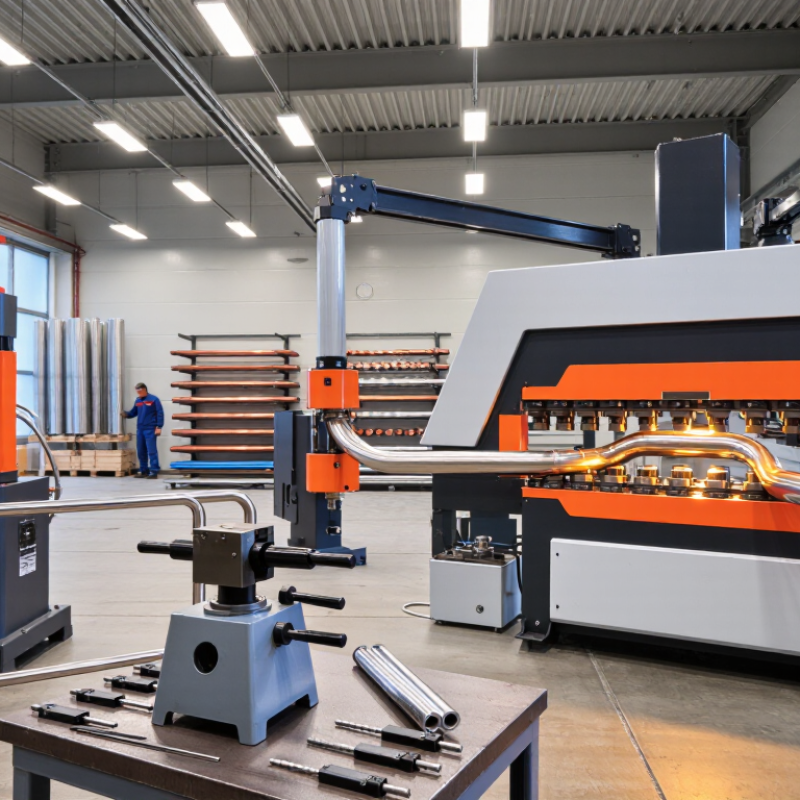
2026 Top Types of Tube Benders for Global Buyers

What Is a Tube Bender and How Does It Work?

A tube bender reshapes metal tubing without cutting it. The machine applies controlled force around a selected bend radius. Its main parts include a clamp die, pressure die, bend die, and, for demanding work, a mandrel.

The principle is simple. The tube is secured, rotated, and formed around the bend die. A mandrel supports the inside wall during tight bends. It helps reduce collapse and wrinkling.

Rotary draw bending offers accurate angles and clean radii. Roll bending suits large, gradual curves. Press bending is faster, but it usually provides less dimensional control.

In shop practice, operators check springback, wall thinning, ovality, and surface marks. A perfect-looking bend can still fail inspection. Small errors matter. Material grade, tube diameter, wall thickness, tooling clearance, and lubrication all affect the result. CNC models can store bend sequences, while manual machines depend more heavily on operator judgment.

Demand for accurate tubing continues to rise in transport and energy equipment. The International Energy Agency’s Global EV Outlook 2025 reported more than 17 million electric cars sold worldwide in 2024. That growth increases the need for repeatable battery, cooling, and structural tube assemblies. ASME B31.3 and related engineering requirements also reinforce the importance of controlled geometry in process piping. Buyers should compare achievable radius, maximum wall thickness, repeatability, and service support.

I would not choose a machine by tonnage alone. That shortcut often hides the real production limits.

Main Types of Tube Benders for Different Applications

2026 Top Types of Tube Benders for Global Buyers

Main Types of Tube Benders for Different Applications

Manual tube benders suit repair shops, prototypes, and low-volume plumbing work. They are affordable, portable, and easy to control. A technician can shape a 25 mm copper tube beside an installation site. However, manual bending depends heavily on operator skill.

Rotary draw benders provide accurate, repeatable curves for automotive frames, exhaust systems, and furniture tubing. Mandrels help protect thin-wall tubes from wrinkles and collapse. CNC versions add programmable rotation, feeding, and bend angles. This matters when production requires hundreds of identical parts. The International Energy Agency reported nearly 14 million electric car sales in 2023, representing about 18% of global new-car sales. That growth increases demand for precise battery, cooling, and structural tube assemblies.

Roll benders create broad-radius curves for architectural rails, heat exchangers, and large pipelines. Press benders handle heavier tubes, though their radius control is less refined. Induction benders use localized heat for thick-wall steel and large diameters. They require careful temperature monitoring. Too much heat can damage surface quality.

Application decides the machine. A 1.5D exhaust bend needs different tooling from a gentle handrail curve. Wall thickness, alloy, radius, ovality, and springback must be tested before purchase. Industry market reports often show strong growth, but their definitions differ. Some include complete forming lines, not tube benders alone. Buyers should review sample parts, tooling costs, and service capability. The cheapest option can become expensive after repeated setup errors.

2026 Top Types of Tube Benders for Global Buyers - Main Types of Tube Benders for Different Applications

A practical comparison of common tube-bending technologies, typical capabilities, suitable materials, and application requirements

Tube Bender Type Typical Tube Size Range* Common Materials Typical Bend Method Best Applications Main Advantages Key Limitations Buyer Considerations
Manual Lever Tube Bender Approximately 6–22 mm outside diameter Copper, aluminum, thin-wall steel, stainless steel in suitable sizes Manual rotary draw bending around a fixed former Plumbing, refrigeration service, hydraulic installation, maintenance work, and prototypes Low purchase cost, portable design, simple operation, and no electrical or hydraulic power required Limited production speed, operator-dependent results, and restricted size and wall-thickness capacity Check included formers, allowable wall thickness, minimum bend radius, and compatibility with the target tube material
Ratchet Tube Bender Approximately 6–28 mm outside diameter Copper, aluminum, annealed steel, and selected stainless steel tubing Incremental mechanical bending using a ratchet mechanism Field installation, HVAC service, automotive repair, and low-volume fabrication Requires less hand force than a basic lever tool and offers better control on larger small-diameter tubes Slower than powered equipment and generally unsuitable for high-volume or highly complex forming Evaluate ratchet stroke, die availability, tube support, portability, and repeatability of bend angles
Compression Tube Bender Approximately 6–50 mm outside diameter Aluminum, copper, mild steel, and stainless steel with appropriate tooling The tube is formed over a stationary or moving former while a pressure die applies force General workshop fabrication, frames, furniture, guards, and light industrial assemblies Relatively simple tooling, moderate productivity, and suitability for standard single-radius bends May produce more ovality or surface marking than advanced rotary draw systems, especially on thin-wall tubes Review pressure-die support, surface finish requirements, tooling accuracy, and acceptable deformation limits
Rotary Draw Tube Bender Approximately 6–220 mm outside diameter, depending on machine configuration Carbon steel, stainless steel, aluminum, copper alloys, and other ductile metals A rotating die draws the tube around a bend die; a clamp die and pressure die control the workpiece Automotive exhaust systems, aerospace structures, industrial piping, furniture, and precision tube assemblies High dimensional accuracy, repeatable bend angles, good surface quality, and tight-radius capability with proper tooling Higher tooling cost, more complex setup, and possible wrinkling or thinning if process parameters are poorly selected Specify centerline radius, material temper, wall thickness, mandrel requirements, and number of bend axes
Mandrel Tube Bender Approximately 12–150 mm outside diameter, depending on tooling and machine size Thin-wall stainless steel, aluminum, titanium, copper alloys, and high-strength steel Rotary draw bending with an internal mandrel and often a wiper die to support the tube wall Tight-radius exhausts, aircraft tubing, motorcycle components, heat exchangers, and fluid lines Controls flattening, wrinkling, and cross-section distortion during tight-radius bends More expensive tooling, longer setup time, and greater requirements for lubrication and process control Confirm mandrel ball design, wiper-die compatibility, lubrication system, tube ovality limits, and tooling changeover time
CNC Tube Bender Approximately 6–220 mm outside diameter, depending on machine class Steel, stainless steel, aluminum, copper alloys, and other production-grade tubing Computer-controlled rotary draw, roll, or combination bending with programmable axes High-volume automotive, aerospace, appliance, energy, and industrial production High repeatability, automatic sequencing, reduced setup variation, and support for multiple bends and planes Higher capital investment, operator training requirements, and greater dependence on accurate digital programs Assess axis count, software functions, automatic loading, measurement feedback, safety systems, and service support
Hydraulic Tube Bender Approximately 20–300 mm outside diameter, depending on hydraulic capacity and tooling Carbon steel, stainless steel, structural steel, and heavy-wall tubing Hydraulic cylinders apply controlled force through former, clamp, and pressure tooling Heavy equipment, structural frames, shipbuilding, construction machinery, and large industrial pipework High bending force, suitability for large diameters, and effective handling of heavy-wall materials Large footprint, higher energy use, slower fine adjustment, and less suitability for very small-radius precision work Check maximum wall thickness, hydraulic pressure, tooling support, machine rigidity, and floor-space requirements
Three-Roll Profile and Tube Bender Approximately 20–300 mm outside diameter for tubes; larger sizes are possible on heavy-duty systems Carbon steel, stainless steel, aluminum, and structural profiles Three rollers progressively form the tube into a curve or large-radius bend Arches, rings, handrails, structural frames, heat-exchanger sections, and large-radius pipe fabrication Effective for continuous curves, large radii, long workpieces, and profiles that are difficult to form with fixed dies Less suitable for short straight sections, very tight radii, or highly complex multi-plane bend sequences Review minimum rolling radius, roller arrangement, section rigidity, end-waste allowance, and profile-specific tooling
Orbital or Incremental Tube Bender Commonly used from approximately 20–150 mm outside diameter Aluminum, stainless steel, titanium, and other ductile engineering alloys The tube is formed progressively through controlled incremental movement or localized forming Complex geometries, low-volume aerospace work, custom prototypes, and applications requiring flexible programming Can reduce the need for dedicated full-form tooling and may support complex shapes with programmable motion Process development can be demanding, cycle times may be longer, and surface or dimensional control depends strongly on calibration Request sample-bend validation, software capabilities, forming-force data, and dimensional inspection procedures
Electric Servo Tube Bender Approximately 6–100 mm outside diameter, depending on machine configuration Stainless steel, aluminum, copper alloys, mild steel, and thin-wall tubing Servo-driven rotary draw or multi-axis bending with electronically controlled motion Precision production, clean manufacturing areas, battery systems, medical equipment, and automated assembly lines Accurate motion control, low hydraulic maintenance, programmable recipes, and good energy efficiency in suitable applications Higher initial cost and possible performance limitations when bending very large or extremely heavy-wall tubes Compare servo torque, axis synchronization, programming interface, data traceability, and electrical requirements
*Tube size ranges are general industry reference ranges rather than universal machine limits. Actual capacity depends on outside diameter, wall thickness, material strength, temper, bend radius, tooling, and machine design. Always confirm the manufacturer's technical specification and validate sample bends before purchase.

Key Features and Specifications to Compare

Choosing tube benders in 2026 requires more than comparing advertised tonnage. A 2024 MarketsandMarkets industry report estimated the tube-bending-machine market at about USD 1.3 billion in 2023, with continued growth through 2028. That expansion reflects demand for repeatable forming in construction, transportation, energy, and furniture production. Buyers should compare actual capacity, not impressive brochure language.

Start with tube diameter and wall thickness. A machine rated for 38 mm steel tubing may handle less stainless steel reliably. Check the minimum bend radius, centerline radius, ovality control, and maximum bend angle. For production work, repeatability near ±0.1° can reduce adjustment time. Rotary-draw models suit precise bends. Roll and press benders fit larger radii or heavier sections. The choice is rarely universal.

Control systems deserve equal attention. Multi-axis machines can reduce handling, while servo drives improve speed consistency and energy control. Confirm whether the controller stores programs, exports production data, and supports automatic springback compensation. Tooling changeover matters, too. A ten-minute setup is very different from an hour beside a hot production line. The International Energy Agency reported that industry accounted for roughly 37% of global energy demand in 2022, making motor efficiency worth measuring. One overlooked detail is serviceability. Ask for spare-part lead times, calibration procedures, guarding standards, and operator training. Some specifications look excellent, but field maintenance may tell another story.

How to Choose a Tube Bender for Global Purchasing

2026 Top Types of Tube Benders for Global Buyers

How to Choose a Tube Bender for Global Purchasing

Choosing a tube bender for global purchasing starts with the tube, not the machine catalog. Record the outside diameter, wall thickness, material grade, bend radius, angle tolerance, and yearly production volume. These details narrow the options quickly. They also expose unsuitable machines early.

Rotary draw benders provide accurate bends for structural, automotive, and industrial tubes. Roll benders work better for large radii and continuous curves. Press benders can handle simpler shapes, but their accuracy may be limited.

Manual benders suit prototypes and low-volume repairs. CNC models support repeated production, although their programming and maintenance require trained operators.

Ask for sample bends using your actual tube material. Measure ovality, wrinkles, springback, surface marks, and angle deviation. A polished sample can still hide production problems. Request the machine’s working range, motor specifications, control language, safety documents, and installation requirements. Electrical standards may differ between countries, so confirm voltage and frequency before ordering.

Review spare-part availability and remote technical support. Delayed replacement tooling can stop a small factory for weeks. Confirm packaging, shipping weight, customs documents, warranty terms, and operator training. Local service may be more valuable than a lower purchase price. An impressive machine can still be the wrong choice. Allow room for uncertainty, especially when material batches vary or future products remain unclear.

Safety, Maintenance, and International Buying Considerations

2026 Top Types of Tube Benders for Global Buyers

Safety, Maintenance, and International Buying Considerations

Choosing a tube bender in 2026 requires more than comparing bending speed. Rotary draw, roll, and press benders create different pinch, crush, and stored-energy risks. The International Labour Organization estimates nearly three million workers die annually from work-related accidents and diseases. That figure makes guarding, emergency stops, two-hand controls, and operator training practical buying requirements, not decorative features. Check ISO 12100 risk-assessment principles and ISO 13849 safety-control documentation before approving a machine.

Maintenance planning also affects total cost. Ask for lubrication charts, electrical diagrams, calibration procedures, and recommended spare-part lists in clear English. A machine with accessible bearings and visible wear points is easier to inspect during a busy shift. Deloitte’s 2022 Global Smart Manufacturing Survey found that 86% of manufacturers viewed smart-factory initiatives as important for competitiveness. However, connected diagnostics cannot replace physical inspections. Sensors may miss a loose clamp. That matters.

International buyers should verify voltage, frequency, guarding configuration, manuals, training, and service response before payment. Confirm whether local technicians can source seals, dies, filters, and control components. Import duties and delivery estimates can change. So can installation requirements. I have found that impressive brochures often omit maintenance downtime and tooling changeover time. A perfect checklist does not exist. Still, requiring documented factory testing, operator training, and realistic acceptance criteria reduces avoidable surprises. Cite: ILO, A Call for Safer and Healthier Working Environments, 2023; Deloitte, 2022 Global Smart Manufacturing Survey.

Article Source: